 (770) 874-6085


 770-874-6085
Magento vs Shopify vs WooCommerce is not primarily a question about which platform can display products and accept a credit card; all three can do that. The real decision is how much technical responsibility, customization, ownership, B2B complexity, integration work and operating cost the store expects to carry as it grows.
A small catalog with standard checkout, a global DTC brand, a wholesale operation with company-specific pricing and a complex manufacturer with multiple inventory sources are all “ecommerce.” They are not the same system.
That is why platform comparisons become misleading when they count features without defining the business model.
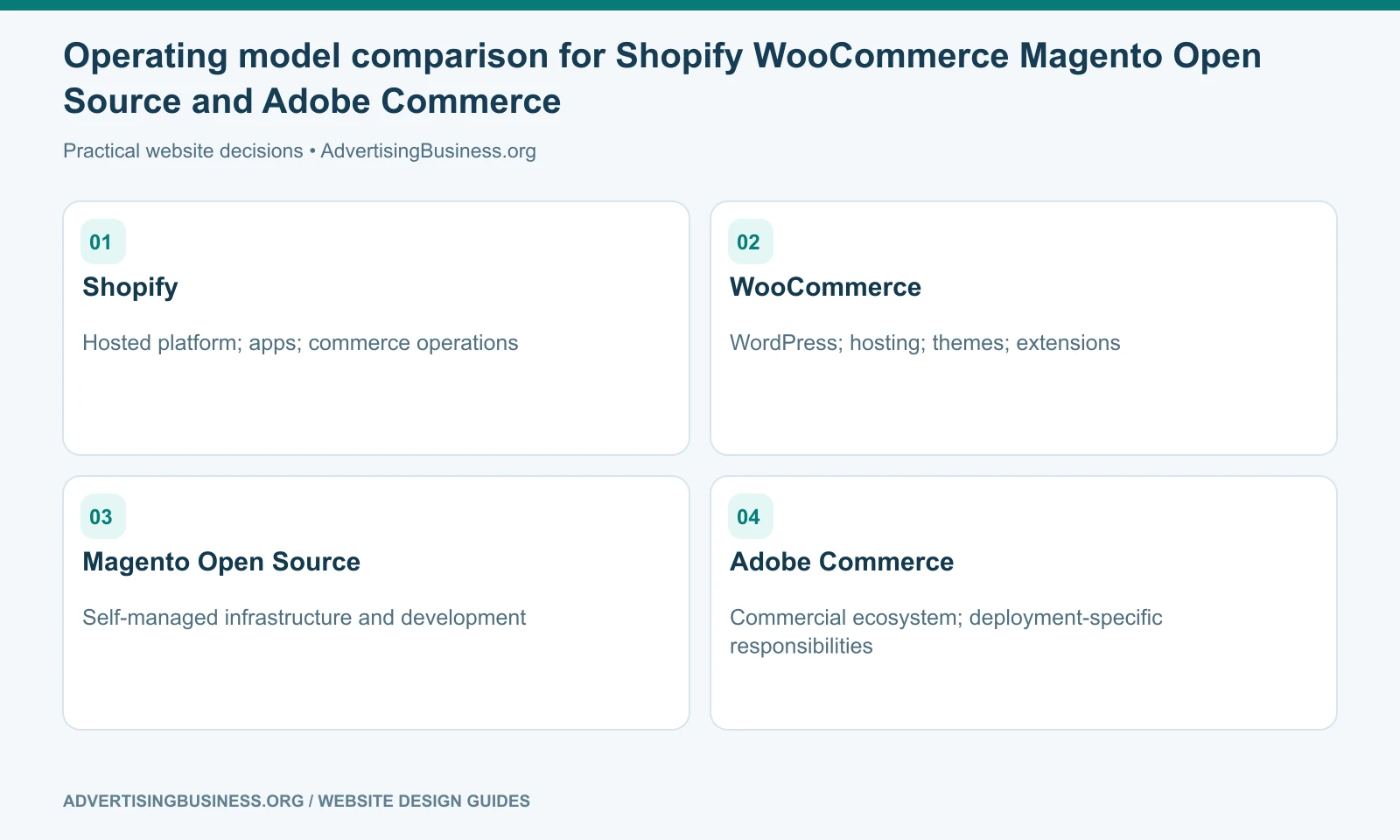
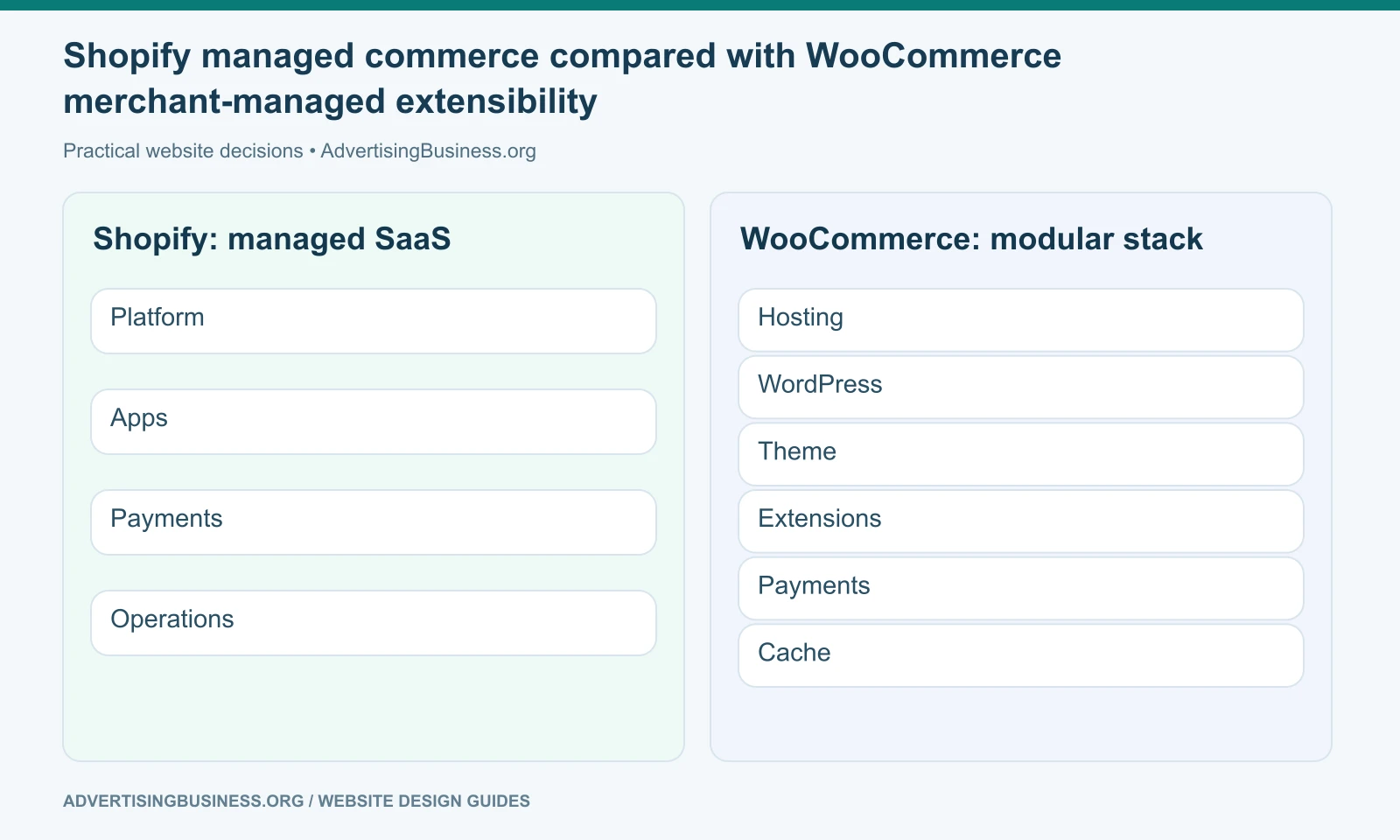
Shopify is a managed commerce platform. The merchant pays the platform to abstract much of the hosting, security, checkout infrastructure and software maintenance.
WooCommerce is an open-source commerce layer built on WordPress. It gives the merchant broad control over hosting, code, extensions and content, while placing more responsibility on the owner or technical team.
Magento now needs a naming distinction. Magento Open Source remains the open-source commerce platform, while Adobe’s commercial enterprise product is Adobe Commerce. Businesses evaluating “Magento” should be clear about which model they mean because the implementation and support expectations can be very different.
Start with the store’s operating complexity, not its current revenue
Revenue alone is a poor platform selector.
A $500,000 store selling twelve simple products domestically may be easier to operate than a $200,000 manufacturer selling 8,000 SKUs, negotiated B2B catalogs and freight-based shipping across several systems.
Map the complexity:
- number of SKUs and variants;
- DTC, B2B or both;
- countries, currencies and markets;
- inventory sources and warehouses;
- subscriptions or memberships;
- product customization;
- tax and shipping logic;
- ERP, PIM, CRM and accounting integrations;
- content/SEO requirements;
- checkout customization;
- internal development capacity;
- uptime and support expectations.
Shopify: the strongest default when managed commerce matters
Shopify’s biggest advantage is not that it has the longest feature list. It is that a large amount of ecommerce infrastructure is delivered as a managed service.
The merchant does not provision the web server, patch the core commerce application or assemble a checkout system from separate plugins. Shopify provides the storefront platform, checkout, hosting, app ecosystem and operational tooling as one service.
That can reduce technical overhead dramatically for brands that want to focus on merchandising, customer acquisition and operations instead of platform maintenance.
Shopify has also expanded its B2B reach. In April 2026, Shopify announced that foundational native B2B capabilities were rolling out beyond Plus to Basic, Grow and Advanced plans, including company profiles, limited custom catalogs, volume rules, vaulted cards and payment terms. More advanced requirements can still justify higher-tier tooling, apps or custom development, but the old assumption that “real Shopify B2B always requires Plus” is no longer accurate as a blanket statement.
Shopify is a strong first look when the merchant values predictable managed infrastructure, a mature app ecosystem, fast deployment and a standardized commerce core.
The tradeoff is platform dependence. The core checkout, hosting model and application framework live inside Shopify’s ecosystem. Deeply unusual requirements may require apps, custom functions or architectural workarounds rather than direct control over the entire stack.
WooCommerce: strongest when WordPress content and control are central
WooCommerce is a customizable, open-source ecommerce platform built on WordPress.
That matters for businesses whose store is also a substantial publishing and SEO system. Products, long-form resources, service content, category pages, landing pages and custom WordPress content can live inside one extensible CMS environment.
WooCommerce’s official feature documentation emphasizes open-source ownership, REST API flexibility and a large extension ecosystem. Woo says there is no WooCommerce platform transaction fee beyond the payment service provider; merchants may still pay hosting, payment processing, premium extensions, development and operational costs.
The flexibility is real. So is the maintenance burden.
A WooCommerce store can involve WordPress core, theme code, WooCommerce, payment extensions, shipping extensions, subscriptions, security tools, caching, analytics and custom integrations. Each component adds capability and potential compatibility work.
That makes WooCommerce a strong fit when the business values control, already has WordPress expertise, needs rich content/SEO flexibility, wants to choose hosting or expects custom WordPress development.
It is a weaker fit when nobody owns maintenance and the company expects the platform vendor to solve every infrastructure issue end to end.
Magento Open Source and Adobe Commerce: strongest when commerce architecture is the project
Magento earned its reputation in complex commerce because it was built for extensibility and serious catalog/transaction workflows.
Today, businesses should distinguish Magento Open Source from Adobe Commerce. Adobe Commerce adds enterprise capabilities, services and commercial support around the Magento lineage.
Adobe’s current Commerce feature documentation includes B2B-ready functionality and APIs, order approval workflows, multi-source inventory, GraphQL, asynchronous and bulk APIs, cloud infrastructure options, content staging and enterprise security tooling.
That capability can also be overkill when the requirements do not justify it.
A small merchant does not gain value simply because an enterprise platform can model more complexity. Magento/Adobe Commerce typically makes more sense when the business has experienced development resources, demanding integrations, complex catalogs, B2B workflows, multiple storefront requirements or architecture that cannot be handled cleanly by a simpler managed platform.
The wrong reason to choose it is “we want something powerful.”
The right reason is “our documented commerce requirements need this degree of control and our organization can operate it.”
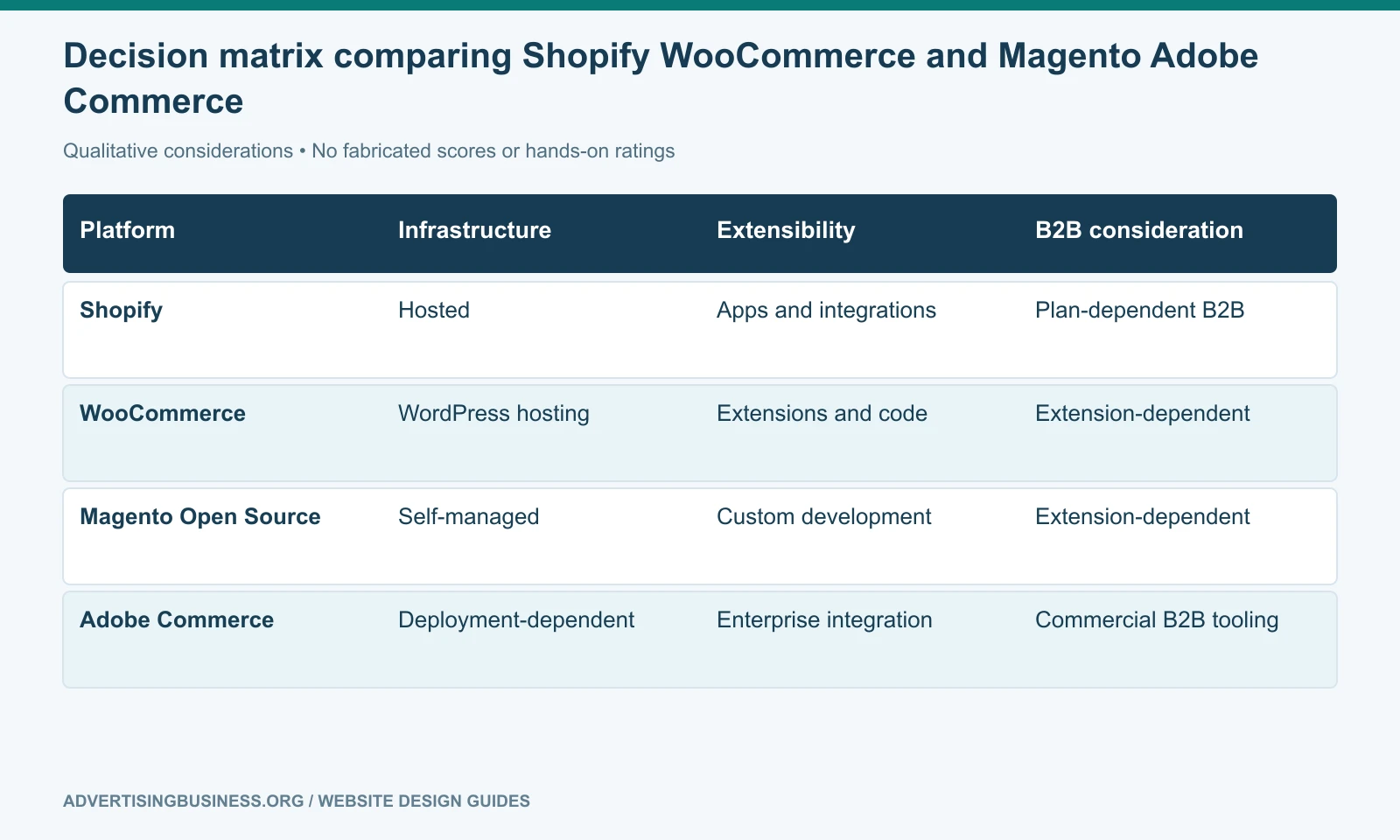
Magento vs Shopify vs WooCommerce at a glance
Magento vs Shopify vs WooCommerce becomes clearer when you compare the operating model instead of trying to declare a universal winner.
| Requirement | Strong first look | Why |
|---|---|---|
| Fast managed DTC launch | Shopify | Core commerce infrastructure is managed |
| WordPress-heavy content + commerce | WooCommerce | Commerce lives inside an extensible WordPress environment |
| Deep enterprise commerce architecture | Adobe Commerce | Enterprise APIs, B2B, inventory and workflow depth |
| Maximum open-source control | WooCommerce or Magento Open Source | Merchant controls more of the software/hosting stack |
| Small team without developers | Shopify | Lower infrastructure responsibility |
| Highly bespoke integrations | WooCommerce, Magento/Adobe Commerce, or Shopify with custom architecture | Decision depends on integration depth and API fit |
| Native B2B starter capabilities | Shopify now deserves evaluation | Foundational B2B features expanded to non-Plus plans in 2026 |
Do not treat this table as procurement approval. Every serious store should validate its must-have integrations and workflows before committing.
SEO depends heavily on the architecture you build
Ecommerce SEO is not solved by choosing a platform with an “SEO” checkbox.
The store needs crawlable category and product URLs, sensible faceted-navigation handling, canonical discipline, useful category content, structured product information, internal links, fast-enough templates, good mobile behavior and a strategy for out-of-stock or discontinued products.
WooCommerce can provide deep WordPress content flexibility. Shopify can provide a highly standardized commerce foundation. Magento can model sophisticated catalogs. None of those benefits automatically fixes duplicate filters, thin category pages, poor product descriptions or orphaned content.
The larger the catalog, the more information architecture matters.
If your store is being built or redesigned, Elite Web Professionals’ ecommerce website design can be linked from the implementation as the commercial next step when relevant.
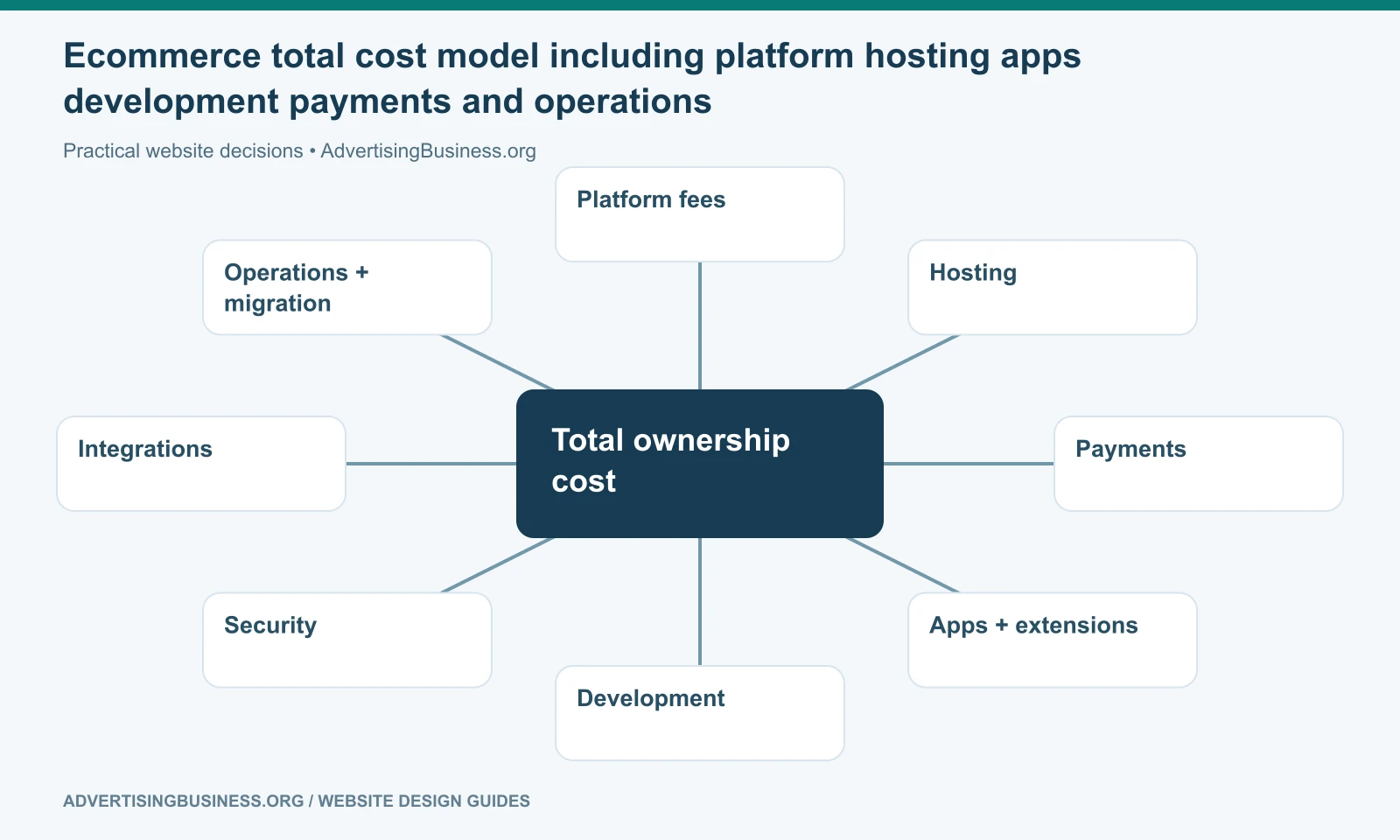
Cost should be modeled as total ownership, not monthly software
Shopify’s monthly plan is easy to see. WooCommerce core can be downloaded without a license fee. Magento Open Source is open source. Those facts do not tell you which system is cheaper to operate.
Model:
- platform subscription or licensing;
- hosting and CDN;
- payment costs;
- premium apps/extensions;
- developer retainers;
- security and monitoring;
- backups;
- upgrade/testing labor;
- integration maintenance;
- agency or internal staff time;
- migration/replatforming risk.
A higher subscription can reduce engineering overhead. Free software can produce a higher total cost if the organization needs substantial custom support. Enterprise software can be economically justified when it automates complexity that would otherwise require manual systems.
Pick the operating model your team can support
A growing store does not need the most powerful platform. It needs a platform that can support the next stage without turning routine commerce into a development project—or complex commerce into a pile of workarounds.
For many small and midsize DTC brands, Shopify deserves the first evaluation. For content-led businesses already committed to WordPress, WooCommerce can be compelling. For complex enterprise or B2B architectures with experienced technical teams, Magento Open Source or Adobe Commerce can justify their additional complexity.
If you want the decision made from requirements instead of platform preference, Elite Web Professionals can map the catalog, conversion path, SEO architecture and integration requirements before the build. Review our Website Design service or contact us with your current platform and growth constraints.
Magento vs Shopify vs WooCommerce should be decided by the store’s real operating model: how it sells, how it integrates, how much control it needs and who will maintain the system after launch. The migration you avoid by choosing correctly is usually more valuable than winning a generic feature comparison.
Frequently asked questions
Is Magento the same as Adobe Commerce?
Magento Open Source remains an open-source commerce platform. Adobe Commerce is the commercial enterprise product in the same product lineage and adds enterprise services and capabilities.
Is Shopify good for B2B in 2026?
Shopify expanded foundational B2B features to Basic, Grow and Advanced plans in April 2026. More complex B2B programs should still validate catalog, permissions, workflow and integration requirements before choosing a plan.
Is WooCommerce free?
WooCommerce core is open source and can be installed without a platform license fee. A production store may still pay for hosting, payment processing, extensions, themes, development, maintenance and other services.
Which platform is best for SEO?
None is automatically best. Choose the platform that lets your team build and maintain the catalog architecture, content, technical controls, performance and internal linking your SEO program requires.
Sources
- Official Shopify B2B update: https://www.shopify.com/news/b2b-for-all
- Official Shopify pricing: https://www.shopify.com/pricing
- Official WooCommerce features: https://woocommerce.com/woocommerce-features/
- Official WooCommerce documentation: https://woocommerce.com/documentation/woocommerce/
- Official Adobe Commerce feature matrix: https://experienceleague.adobe.com/en/docs/commerce-operations/release/features
- https://www.advertisingbusiness.org/ecommerce-design/

 customersupport@advertisingbusiness.org
 (770) 874-6085