 (770) 874-6085


 770-874-6085
About Us and Our Team pages are where a business can turn anonymous marketing claims into identifiable people, history, qualifications and evidence that a visitor can evaluate.
A homepage usually answers “What do you do?”
A service page answers “Can you solve this problem?”
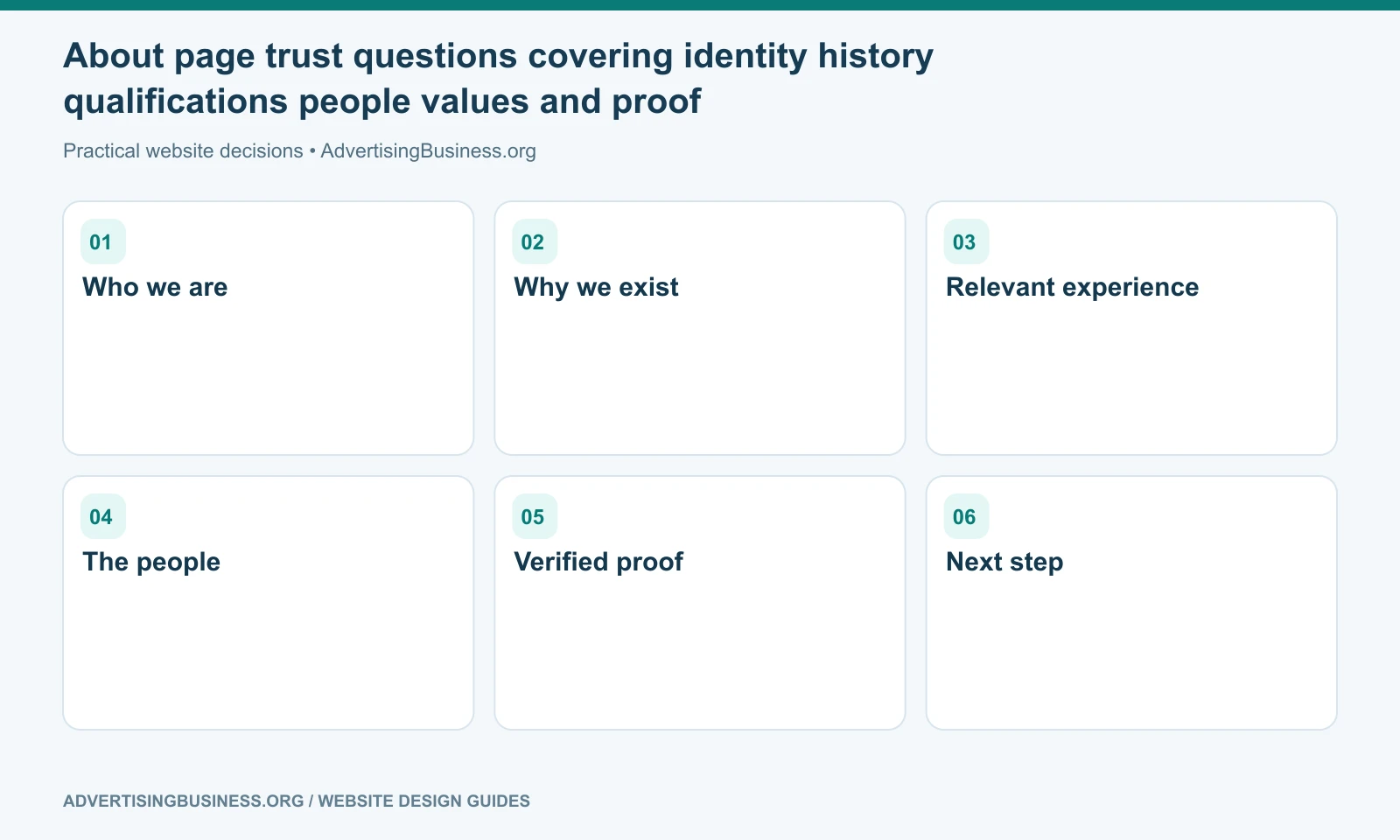
An About page answers a different set of questions: Who are you? Why should I believe you? What kind of company am I dealing with?
Those questions matter most when trust is part of the purchase—professional services, healthcare, home services, consulting, education, nonprofits, high-ticket products, B2B relationships and any service where the customer is inviting real people into their business or home.
The biggest mistake is turning the page into a corporate autobiography that never reconnects the story to the customer.
The second biggest is replacing truth with generic stock photography, invented milestones and empty values such as “integrity, excellence and innovation” without any evidence of how those values appear in the work.
Start with what the visitor needs to know about the company now
Do not make the first paragraph a chronology.
Start with the present-day identity: what the company does, who it serves, where it operates and what makes its approach meaningfully different.
Then the history has context.
A 25-year story matters when it explains accumulated expertise, continuity or why the company works a certain way. A founder story matters when it explains the insight behind the service. A family-business story matters when it connects to actual ownership and customer experience.
History should support the current promise—not replace it.
Google’s people-first content guidance encourages publishers to make authorship and the “Who, How and Why” behind content clear when that context helps people assess the material. The same transparency principle is useful on a company website: identify the people and process behind the claims instead of presenting the brand as a faceless voice.
Use real photography when the people are part of the trust decision
A real team photo does more work than a stock-photo handshake when the customer may meet those people.
You do not need a luxury commercial shoot for every employee. Consistency matters more than extravagance: similar framing, good natural or studio light, appropriate background, accurate color and current photos.
For a founder-led brand, use at least one environmental portrait that shows the person in a credible work context. For a local service business, field/team photos can show that the company actually exists and operates. For healthcare or professional services, portraits should feel approachable without undermining professionalism.
Do not silently generate synthetic employees or use AI headshots that imply people work at the business when they do not.
If an image is illustrative or AI-generated, it should not be used as identity proof.

Build the founder story around a customer-relevant turning point
A useful founder story has structure:
Before: What problem or gap did the founder observe?
Decision: Why did they create or change the company?
Method: What did they learn that now shapes the approach?
Today: What does the company do differently because of that history?
Future: What is the company building toward?
This prevents the story from becoming a resume dump.
For a mature business, the founder does not need to be the only protagonist. The story can evolve into the company’s systems, team and culture so the website does not imply every customer experience depends on one person.
A team page needs more than names and titles
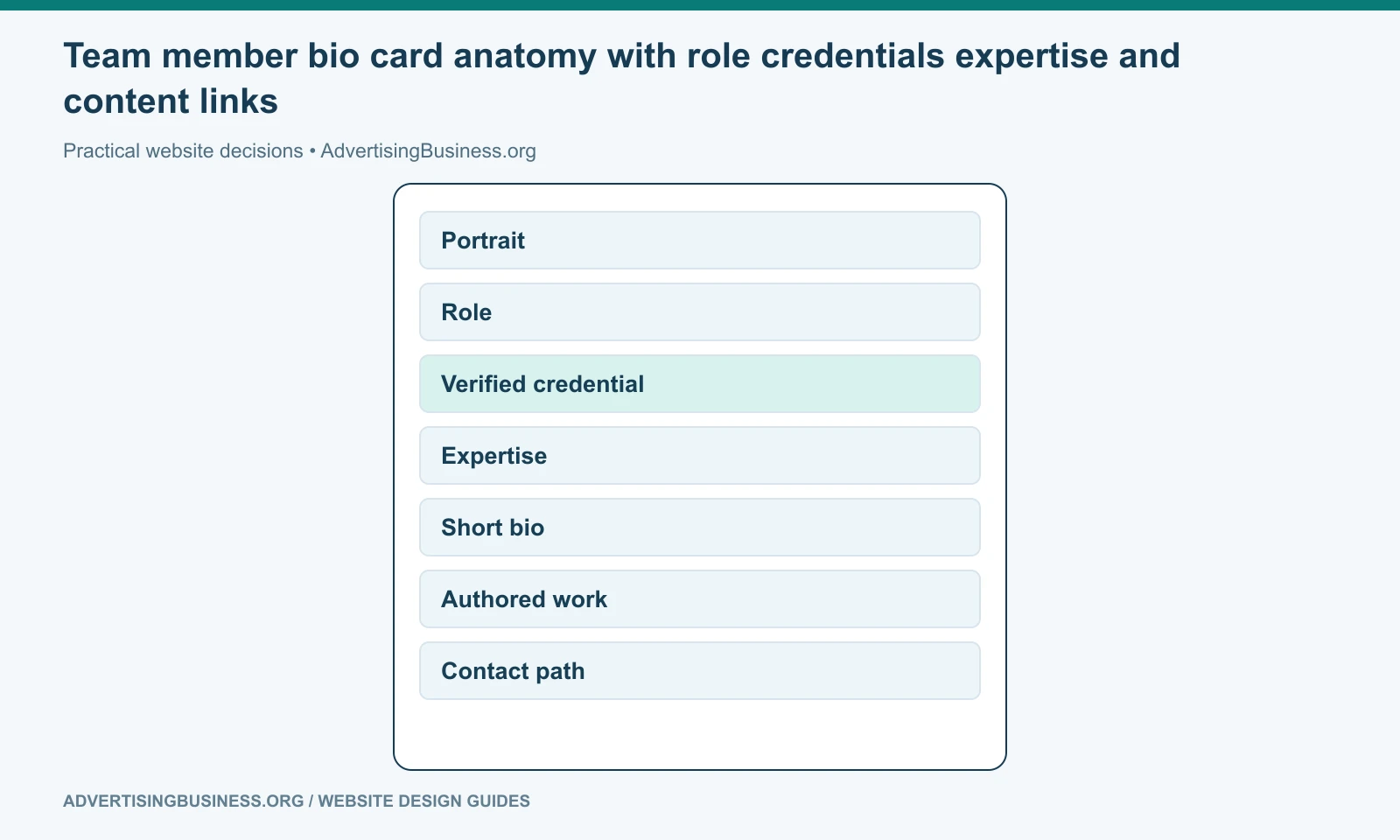
A useful team profile can include:
- name and role;
- professional photo;
- responsibilities;
- relevant credentials or licenses;
- areas of expertise;
- years or type of experience when verified;
- selected professional memberships;
- media/speaking links where appropriate;
- short human detail that supports connection without becoming filler;
- link to authored articles or case studies when relevant.
Do not publish sensitive employee information simply to make a profile look complete.
The level of detail should match the industry. A surgeon, attorney, financial professional or technical specialist may need more credential depth than a general retail employee directory.
About Us and Our Team pages should make the organization more understandable and verifiable, not expose every detail about every employee.
Show credentials where the visitor is deciding whether they matter
A license, certification or professional association is stronger when its relevance is clear.
Place credentials near the person or service they support. Link to a public verification source when practical. Use exact credential names rather than decorative badge graphics that cannot be interpreted.
If a credential has expired, remove it.
If the company has awards, state the awarding organization and year rather than writing “award-winning” indefinitely.
If the business has measurable history—founding year, number of locations, patents, completed projects—use only figures that can be supported and date volatile numbers where necessary.
Trust is strongest when a visitor could verify the claim.
Values need behavioral evidence
Nearly every company claims integrity, quality and customer service.
Instead of listing values as nouns, show what they cause the company to do.
“Transparency” might mean published scopes, clear change orders or no hidden fees. “Craftsmanship” may be reflected in a documented quality-control process. “Accessibility” may mean specific design/testing standards. “Community” may be shown through a named program or ongoing partnership.
A value becomes credible when it changes behavior.
That same logic applies to culture content on recruitment pages. Do not stage a “fun culture” photo and leave candidates with no information about work expectations, development, benefits or leadership.
Add proof, but do not turn the About page into a trophy room
Relevant proof can include:
- dated milestones;
- certifications;
- client/customer categories;
- selected testimonials with permission;
- case-study links;
- media coverage;
- real community involvement;
- association memberships;
- office or facility photos;
- process documentation;
- founder or team-authored expertise.
The About page can route into deeper proof rather than carrying all of it.
For example, a case-study card can link to the full project. A team member can link to articles they wrote. A company timeline can link to a press announcement. That creates a credible internal-link network instead of repeating the same trust claim everywhere.
Our internal linking strategy guide explains how those relationships help visitors move from orientation to evidence.
About page layout: a practical order
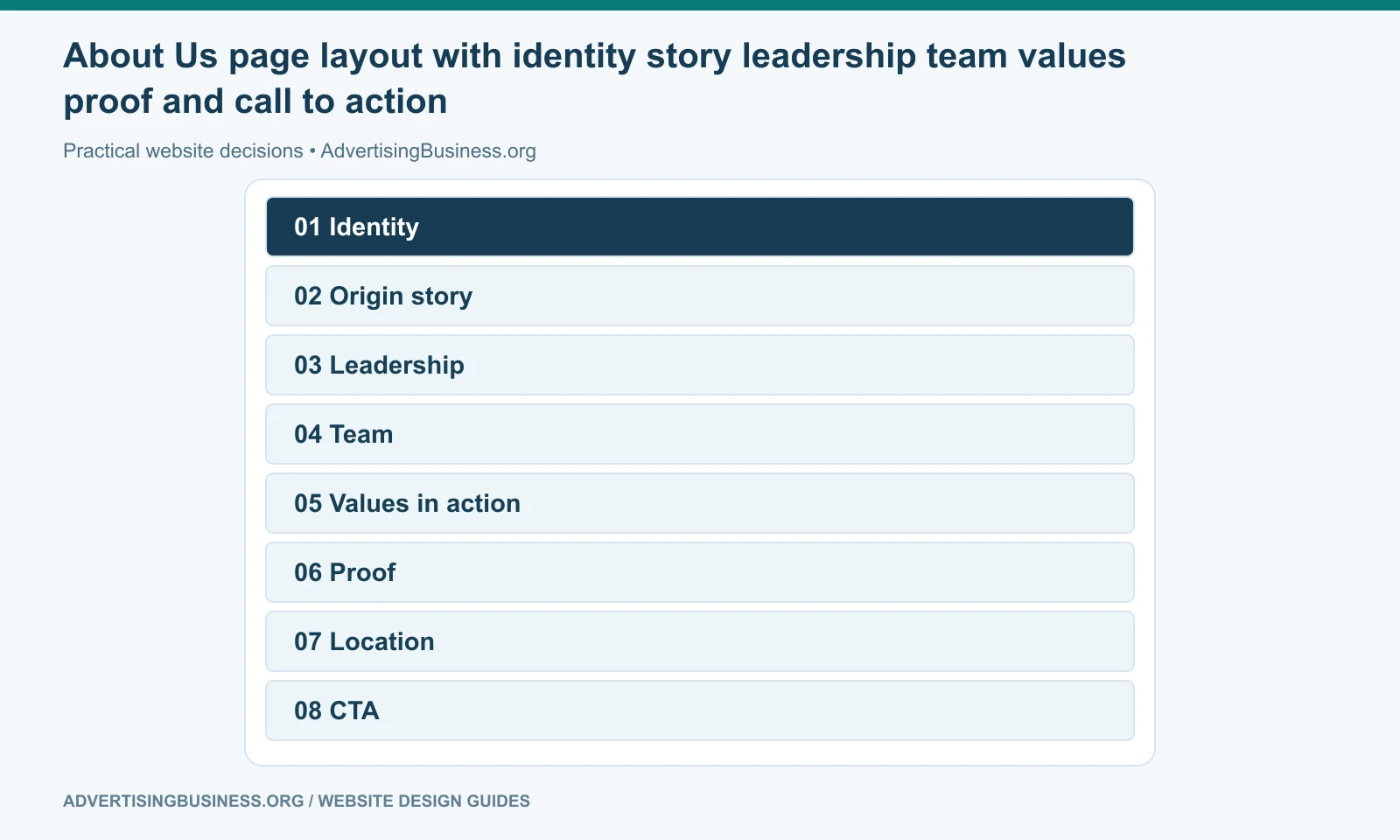
A strong general layout is:
- Identity hero — who the company is now and who it serves.
- Origin/mission — why it exists and what shaped the approach.
- Founder or leadership — accountable people behind the brand.
- Team — the people who deliver the work.
- How we work — process, standards or principles with behavioral evidence.
- Proof — credentials, milestones, cases or verified recognition.
- Local/operational reality — office, service area, facility or how the team works.
- Next step — contact, consultation, careers, services or another appropriate path.
Not every business needs all eight sections. A solo consultant may combine founder and team. A 500-person corporation may move the directory to a separate leadership page.
Give the page a next step
An About page is not a dead-end biography.
After learning who the company is, the visitor may be ready to view services, read case studies, meet a specialist, see careers or contact the business.
Choose the action based on intent.
A person who came from a service page may need a consultation. A candidate may need Careers. A journalist may need a media contact. A potential partner may need leadership information.
If your About page still reads like template filler, Elite Web Professionals can redesign it as part of a website trust system. Review our Website Design service or contact us to plan the right identity, proof and conversion path.
About Us and Our Team pages build trust when they make the company more specific, human and verifiable: real people, real qualifications, real history, real operating principles and a clear path for the visitor to continue the relationship.
Frequently asked questions
What should an About Us page include?
Include present-day company identity, customer relevance, origin or mission, leadership/team information, credible proof, how the company works and an appropriate next step.
Should every employee be on the Team page?
No. The page should include the people relevant to customer, stakeholder or recruiting decisions while respecting privacy and keeping the information maintainable.
Are stock photos okay on an About page?
They can support general design, but they should not be used to imply that anonymous stock models are the actual staff. Use authentic photography when identity is part of the trust decision.
Should team members have individual bio pages?
Create individual pages when the person has enough relevant credentials, expertise, authored content, media or customer-facing responsibility to justify a dedicated search/user destination.
Sources
- Google people-first content guidance: https://developers.google.com/search/docs/fundamentals/creating-helpful-content
- W3C page-structure guidance: https://www.w3.org/WAI/tutorials/page-structure/
- https://www.advertisingbusiness.org/internal-linking-strategy-guide-right-page/
- https://www.advertisingbusiness.org/how-we-approach-atlanta-website-design-with-purpose-and-precision/

 customersupport@advertisingbusiness.org
 (770) 874-6085