 (770) 874-6085


 770-874-6085
Types of Business Websites matter because two companies can both ask for a “new website” while actually needing completely different systems.
A roofing company needs a site that turns urgent local searches into phone calls and estimate requests. A consultant may need a authority-building site that sells expertise before a strategy call. A restaurant may need location information, menus, reservations, and mobile speed. A SaaS company needs product explanation, onboarding paths, integrations, pricing logic, and proof that a buyer can understand before talking with sales. An ecommerce store needs product discovery, checkout, payments, shipping logic, order communication, merchandising, and retention.
Calling all of those projects “a website” hides the most important planning decision: what job does the website have to perform for the business?
That job should determine the page architecture, platform, content depth, analytics, integrations, conversion path, and budget. The visual design comes after that decision, not before it.
Google’s current Search guidance still emphasizes crawlable links, visible textual content, useful structure, and a strong experience across devices. Those fundamentals apply across website types, but the way they are implemented changes depending on the business model.
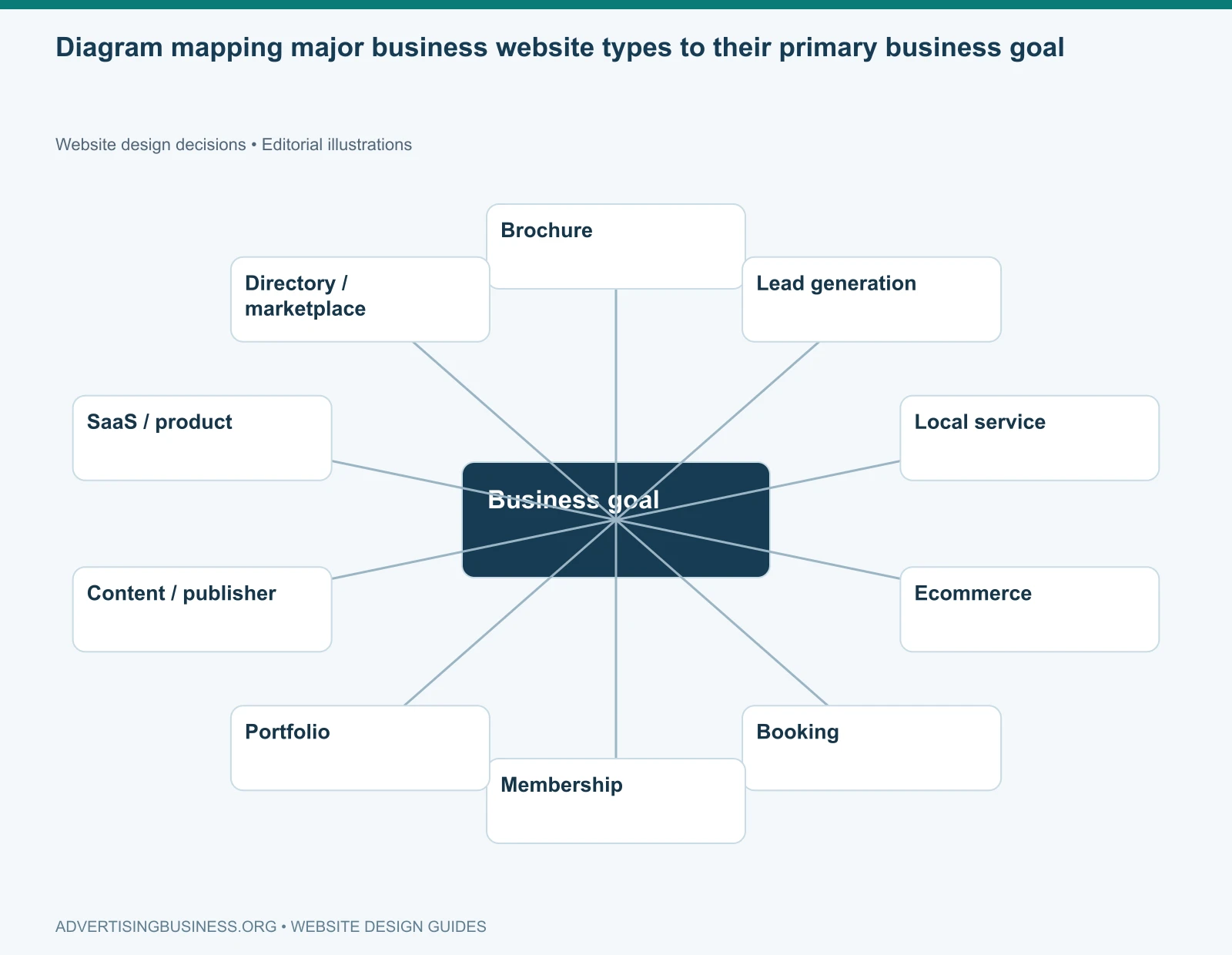
A brochure website is mainly about credibility
A brochure site is the simplest recognizable business website. It explains who the company is, what it offers, why it is credible, and how to contact it.
For some organizations, that is enough.
A small B2B firm that receives nearly all new business through referrals may primarily need a professional destination prospects can use to verify the company after someone makes an introduction. The site does not need hundreds of pages or advanced automation if the real sales process happens elsewhere.
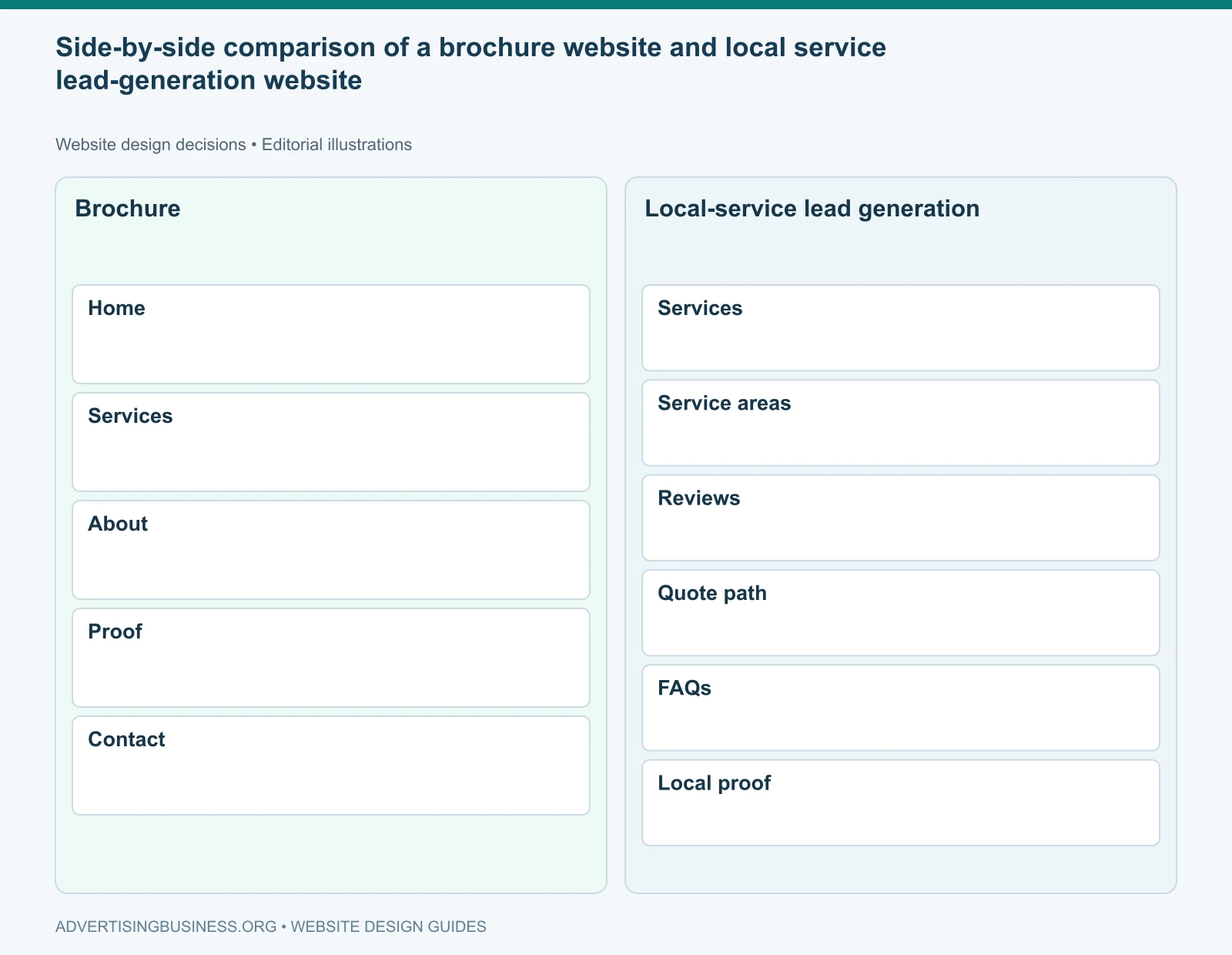
A good brochure site still needs strong fundamentals: a clear homepage, services, About page, proof, contact information, mobile usability, analytics, privacy/legal pages where appropriate, and an easy path to the next action.
The mistake is assuming “brochure” means “generic.” A five-page website can be strategically strong if every page answers a real buyer question.
A lead-generation website has to do more than explain the company
A lead-generation website is designed to convert interest into a measurable inquiry.
Professional services, contractors, agencies, financial firms, legal practices, medical providers, and many B2B companies use this model.
The site needs dedicated pages for important services, strong proof, clear calls to action, form and phone tracking, analytics, persuasive copy, internal links, and enough depth to support both paid and organic traffic.
This is where page architecture becomes important. A company with five distinct services often needs more than one generic Services page because each service can represent a different customer problem, search intent, proof requirement, and conversion path.
That is also why a lead-generation site often grows over time. New service pages, case studies, location pages, comparison content, FAQs, and thought leadership can expand the number of ways qualified buyers enter the business.
If this is your model, our Service Page Layout and Website Hero Section guides provide the page-level structure behind that system.
A local-service website has to answer “Do you serve me?” immediately
Local-service websites are a specialized form of lead-generation site.
Roofers, plumbers, HVAC companies, cleaners, electricians, landscapers, dentists, contractors, and other location-dependent businesses need to establish three things quickly: what they do, where they do it, and why a local buyer should trust them.
That usually requires service pages, service-area information, reviews or other proof, mobile-first call paths, hours, business identity, local contact details, photos, and a fast path to booking or requesting an estimate.
A local-service site should not manufacture dozens of thin city pages purely to target keyword variations. Distinct location content should exist because the business genuinely serves those markets and can provide useful local information.
Ecommerce websites are operating systems for transactions
An ecommerce website is not simply a brochure site with product pages added.
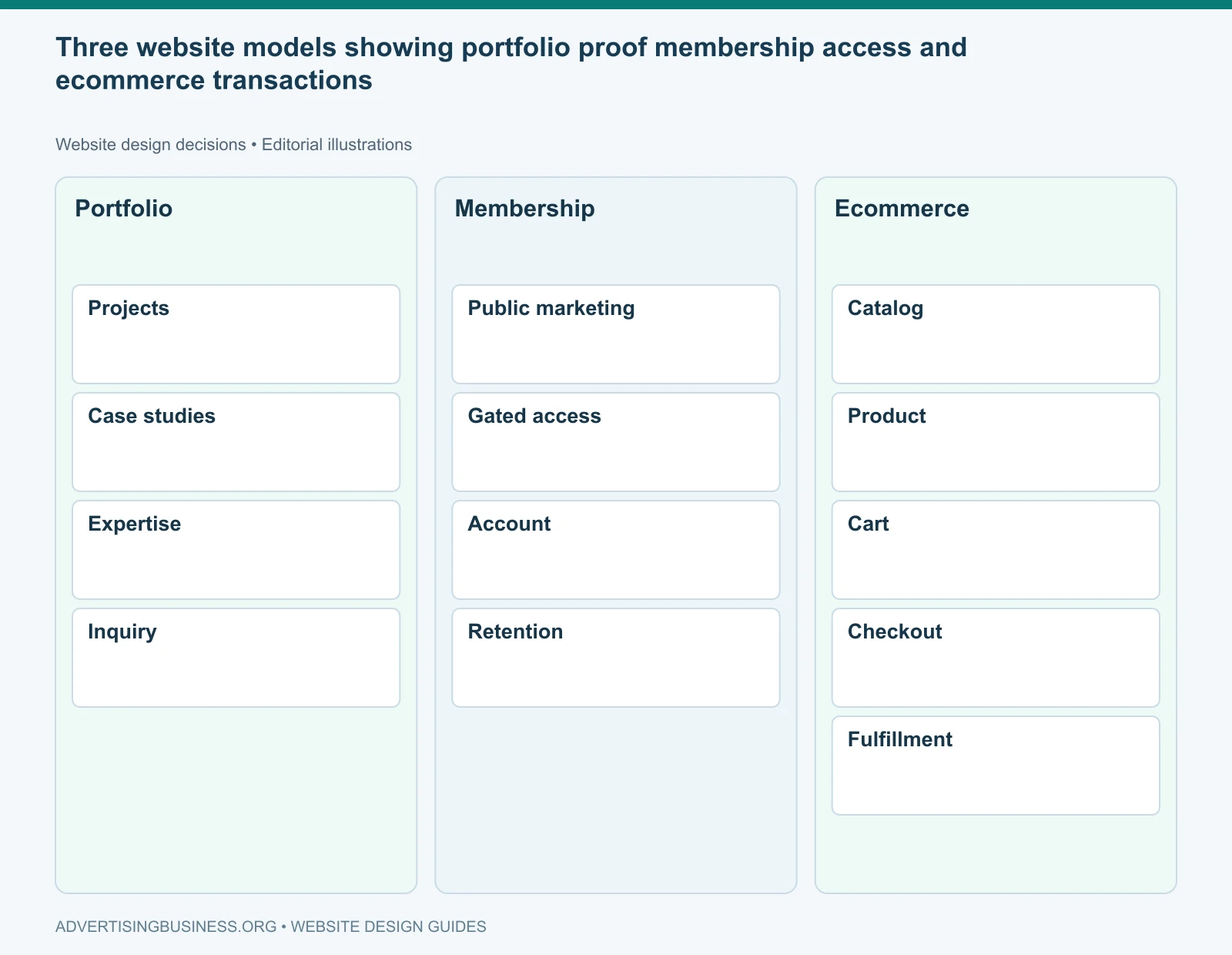
The platform needs to handle catalog structure, product variants, inventory, checkout, payment processing, taxes, shipping rules, returns, transactional email, discounts, customer accounts where appropriate, analytics, product feeds, and merchandising.
The content challenge is different too. Category pages, product descriptions, comparison tools, reviews, specifications, FAQs, and post-purchase communication all influence the experience.
For a growing store, platform choice becomes a business infrastructure decision. That is why we treat Magento vs Shopify vs WooCommerce as a separate decision from ordinary website design.
Booking and appointment websites revolve around availability
A booking website has one primary job: move a qualified visitor into a scheduled time or reservation with as little friction as possible.
That includes salons, consultants, medical practices, fitness businesses, rental companies, restaurants, photographers, home-service providers, and many professional services.
The website needs to explain the offer, prepare the customer for the appointment, collect necessary information, connect to a scheduling system, manage availability, and confirm the next step.
The key is deciding what belongs on the website versus inside the booking platform. If the customer needs to answer ten questions before choosing a time, the website should resolve some of those questions first.
Membership and course websites have an access problem to solve
Membership, training, education, community, and course websites divide the experience between public marketing content and private member content.
The public website must sell the outcome, explain the program, establish credibility, answer objections, and support enrollment. The private experience may need accounts, gated lessons, progress tracking, downloads, payment status, community features, certifications, or recurring billing.
Security, account management, ownership of content, and platform portability matter more here than on a simple brochure site.
A creator may start with an all-in-one platform because it launches quickly, then later discover that moving members, payments, lessons, and data is much harder than moving a normal five-page website. That migration risk should be considered before launch.
Portfolio websites sell evidence
A portfolio site exists to make work visible.
Designers, photographers, developers, architects, builders, creative agencies, filmmakers, and other project-based businesses need more than a grid of images. The visitor needs context: What was the problem? What did you do? What changed? What type of client was it? Is this relevant to my project?
The strongest portfolio sites combine visuals with concise case-study thinking.
That is why a Website Design Portfolio should help a prospect understand the kind of problems the company solves, not merely prove that images exist.
Content and publisher websites depend on information architecture
A content-led website—news publication, educational resource, industry blog, research library, or media brand—has to make a growing archive usable.
Categories, tags, search, internal linking, author pages, topic hubs, structured navigation, related content, and strong templates matter because the number of pages grows continuously.
The business model may be advertising, subscriptions, affiliate revenue, lead generation, sponsorship, or authority. The design has to support reading first.
For sites like AdvertisingBusiness.org, content architecture becomes a strategic asset because articles should not exist as isolated posts. They should reinforce topical hubs, commercial pages, and related resources.
SaaS and product websites must reduce product complexity
A SaaS website has to explain software without making the visitor use it first.
That often requires product pages, feature pages, use cases, integrations, pricing, security, comparison pages, documentation, demos, product video, customer stories, and signup or sales paths.
The page structure should be organized around customer problems and jobs rather than the internal software roadmap.
A product team may have dozens of features, but a buyer rarely wants to learn them in the order engineering built them.
Directories and marketplaces need two customer journeys
A directory or marketplace connects multiple sides of a transaction.
That might mean buyers and sellers, clients and professionals, landlords and renters, travelers and properties, or businesses and service providers.
The website needs search, filtering, profiles or listings, account management, moderation, payments or inquiries, review logic, data quality, and rules for what appears publicly.
The biggest planning mistake is designing only for the person searching and forgetting the experience of the person creating or maintaining the listing.
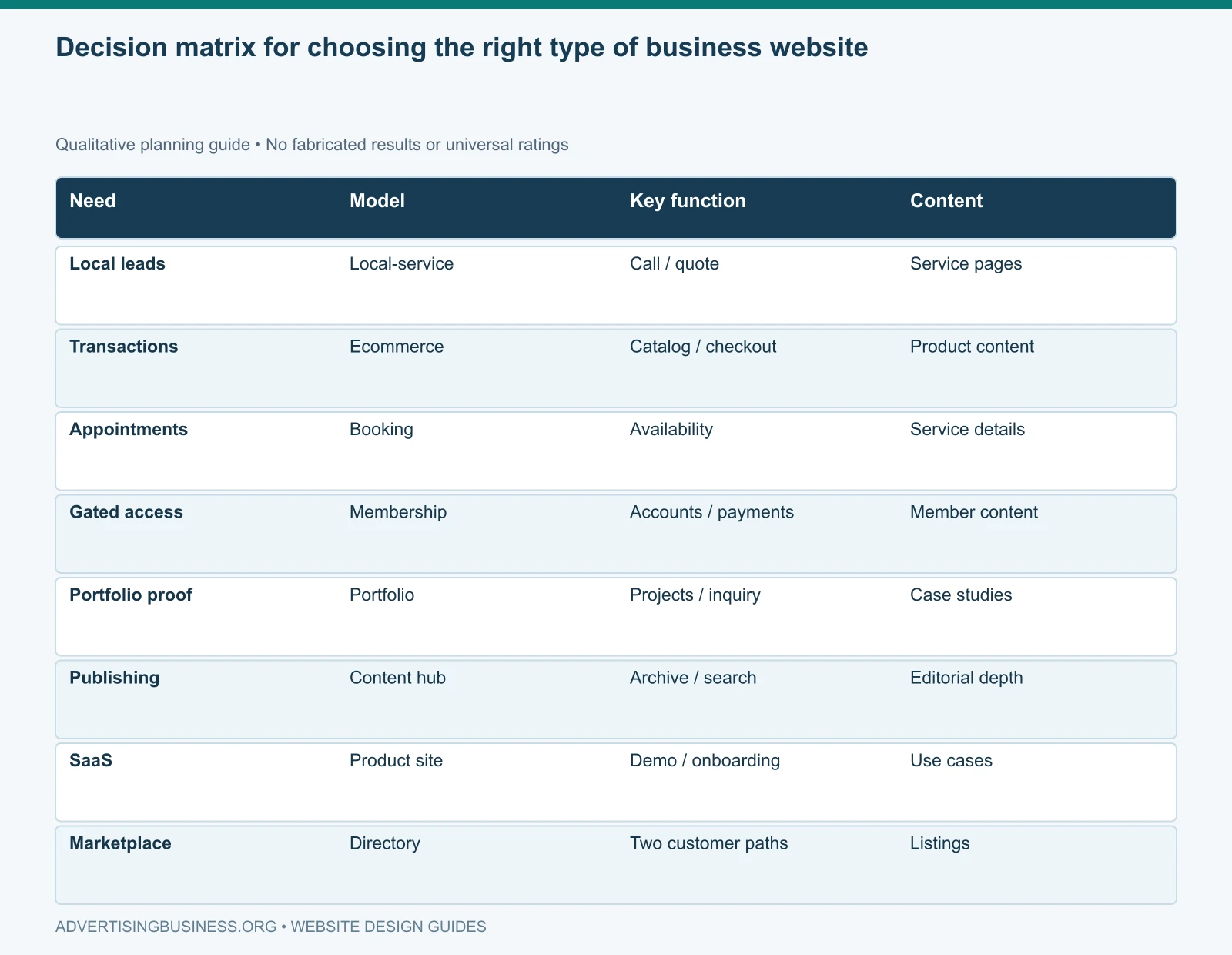
Most businesses are hybrids
A single company may combine several of these models.
A contractor may need local lead generation plus a portfolio. A consultant may need authority content plus appointment booking. A retailer may have ecommerce plus local-store pages. A SaaS company may run a large content publication to create demand. A training company may combine lead generation, ecommerce, membership, and a resource library.
That does not mean the architecture should feel fragmented.
The customer should experience one coherent business. The backend can use multiple systems as long as the navigation, branding, data flow, analytics, and customer journey make sense together.
Understanding Types of Business Websites prevents a company from paying for features it does not need—or discovering after launch that it omitted the functions that drive revenue.
Build the website around the job it must perform
If you are deciding what kind of website your company actually needs, Elite Web Professionals can help map the business goal, customer journey, content, integrations, and growth requirements before the build starts. Review our Website Design service or contact us to plan the right architecture before paying for the wrong one.
Types of Business Websites are best treated as starting models rather than rigid categories, because the strongest business sites often combine several jobs under one coherent architecture.
Frequently asked questions
What is the most common type of small-business website?
Many small businesses use a lead-generation or brochure-style website, but the right model depends on whether the site must generate inquiries, support transactions, schedule appointments, publish content, or provide member access.
How many pages does a business website need?
There is no universal number. A website needs enough pages to give distinct services, audiences, locations, products, or customer questions the depth they genuinely require.
Is ecommerce a separate type of website?
Yes. Ecommerce adds transactional requirements such as catalog management, checkout, payments, shipping, order communication, product data, and merchandising.
Can one website combine several website types?
Yes. Many strong business websites are hybrids, such as a local-service site with a portfolio and booking system or a SaaS site with a large content publication.
Sources
- Official source: Google Search Central — SEO Guide for Web Developers: https://developers.google.com/search/docs/fundamentals/get-started-developers
- Google Search Central — Link Best Practices: https://developers.google.com/search/docs/crawling-indexing/links-crawlable
- W3C — WCAG 2.2: https://www.w3.org/TR/WCAG22/
- AdvertisingBusiness.org — Website Design Services by Industry: https://www.advertisingbusiness.org/industries-served/

 customersupport@advertisingbusiness.org
 (770) 874-6085