 (770) 874-6085


 770-874-6085
Google AI Max September 2026 changes are about to begin for campaigns using Automatically Created Assets and campaign-level broad match, while the broader Dynamic Search Ads migration has been delayed. Advertisers therefore need a campaign-by-campaign audit, not a blanket assumption that every Search campaign will change in the same way or on the same date.
Quick Answer
Beginning in September 2026, Google says eligible Search campaigns using Automatically Created Assets and campaign-level broad match will transition those settings into AI Max. Dynamic Search Ads now have a separate February 2027 migration timetable. Before accepting or testing more automation, verify campaign notices, generated text, query matching, brand and location controls, landing pages, conversions, lead quality, revenue feedback, and written stop rules.
Key Facts at a Glance
| Area | Verified status | Advertiser response |
|---|---|---|
| Automatically Created Assets | Transition to AI Max text customization begins September 2026 | Review generated text and landing-page relevance |
| Campaign-level broad match | Transition to AI Max search-term matching begins September 2026 | Export settings and monitor search terms and exclusions |
| Dynamic Search Ads | Sunset and automatic migration delayed to February 2027 | Use the added time to audit page feeds and landing pages |
| Multi-campaign experiments | Budget and ROI-target A/B tests begin rolling out in September | Define one business question and an external success metric |
What Is Actually Changing in September
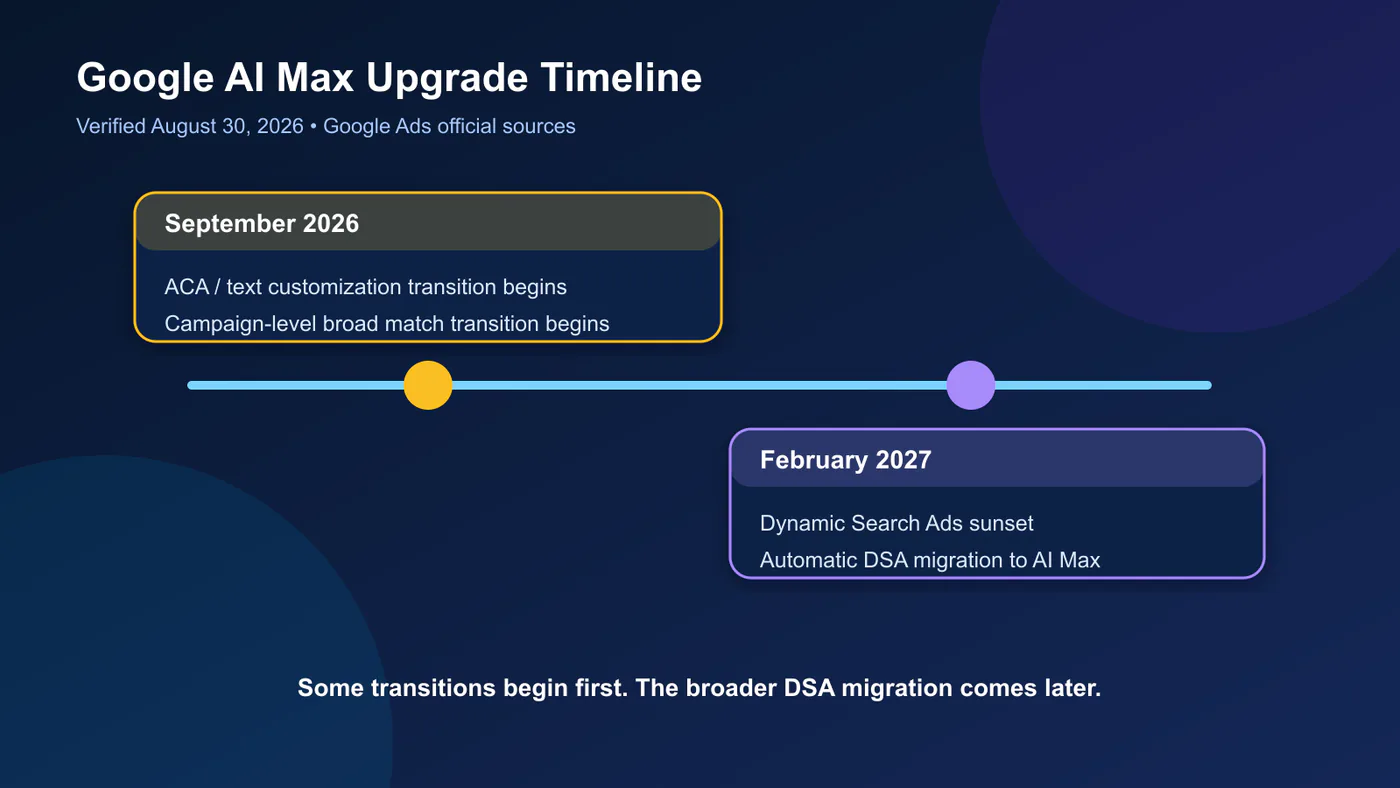
Google’s current help documentation separates three related transitions. Automatically Created Assets, renamed text customization, are being incorporated into AI Max. Google also says the campaign-level broad match setting is being incorporated into AI Max search-term matching. Those two transitions begin in September 2026 for eligible campaigns.
The broader Dynamic Search Ads plan is different. Google updated its announcement on June 11 and extended the DSA sunset and automatic migration to February 2027. That distinction matters because headlines that treat every AI Max change as one September switch can cause teams to audit the wrong campaigns or assume a control disappeared before it did.
What the Auto-Upgrades Mean for Campaign Control
An auto-upgrade changes where a setting is managed; it does not validate the business strategy behind that setting. Text customization may generate or adapt ad text from information Google can use. Search-term matching may expand how campaigns find relevant queries. Both can save manual work, but both can also magnify weak inputs, including vague website copy, outdated offers, thin location pages, poor exclusions, or conversions that reward low-quality inquiries.
Take a dated export or screenshot of each affected campaign before the transition. Record the current setting, brand rules, location rules, exclusions, landing-page options, conversion actions, bidding strategy, budget, and target. After the change, compare the saved baseline with the new AI Max controls. The goal is an auditable record of what changed, not a memory-based debate after performance moves.
The New Testing Tools Can Reduce Guesswork
Google announced a multi-campaign A/B test that can compare changes to budgets or return-on-investment targets across several Search campaigns. Google also says selected brand and location settings can remain enabled in AI Max experiments. This is more useful than a loose before-and-after comparison because a control and treatment can operate during the same market conditions.
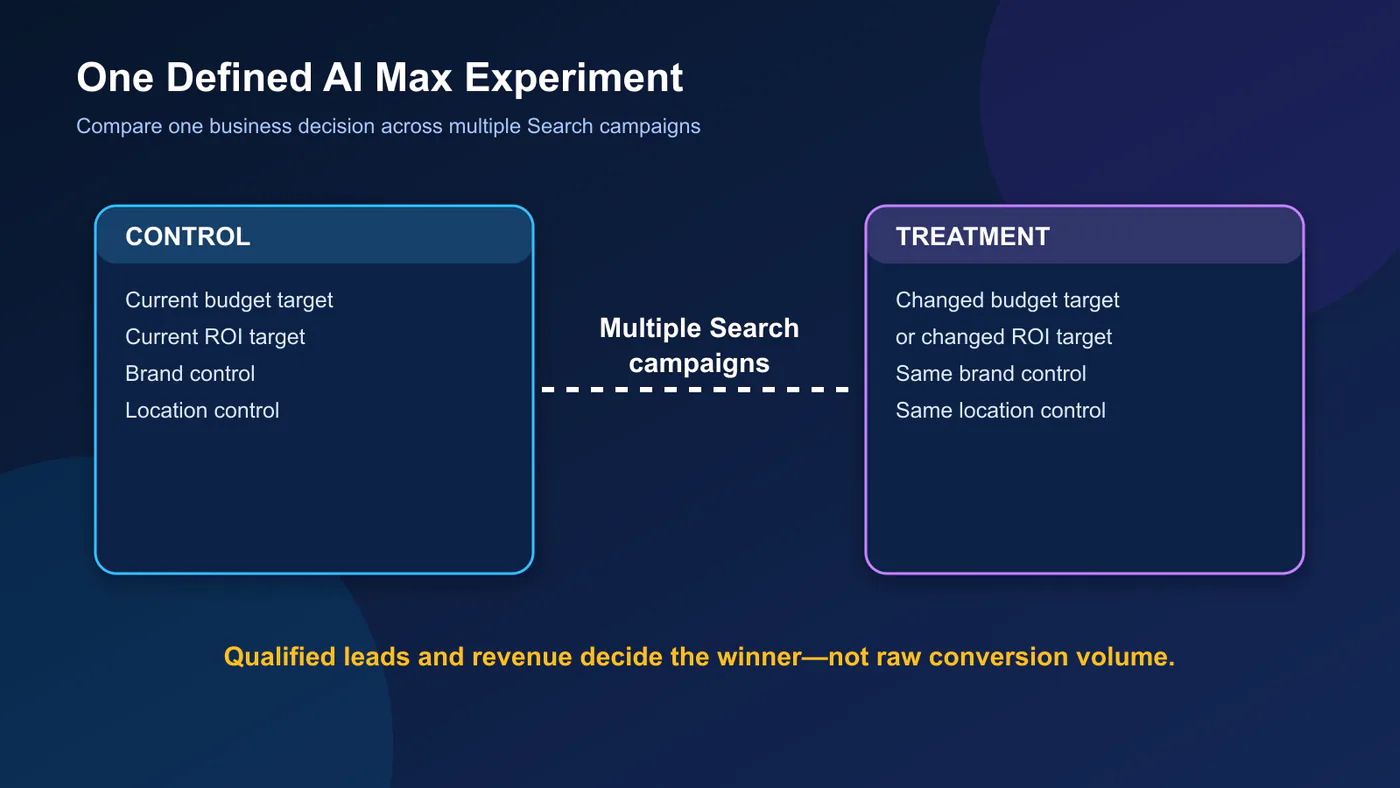
Still, the test should change one defined business decision. Do not simultaneously alter budgets, ROI targets, landing pages, conversion definitions, and sales follow-up, then attribute the result to AI Max. Write the hypothesis, eligible campaigns, control, treatment, guardrails, minimum duration, stop conditions, and decision rule before launch. Measure qualified leads and revenue outside the ad platform as well as platform conversions.
Facts, Rollout Uncertainty, and Account-Level Evidence
Verified: Google’s official pages identify September transitions for text customization and campaign-level broad match, a February 2027 DSA migration, and a September rollout for multi-campaign budget and ROI-target tests. Not yet universal: rollout timing, account eligibility, interface labels, and the exact controls shown to an individual advertiser can vary. An announcement is not evidence that a specific account changed today.
Use the account’s notifications, change history, experiment setup, and current help links as the operational record. If the interface conflicts with an older article or screenshot, pause and document the discrepancy. Do not infer the effect on cost, lead volume, or revenue before sufficient account-level data exists.
Three Business Use Cases That Expose Different Risks
A home-services company may want more booked jobs without sending crews outside a service area. A commercial security integrator may need projects above a minimum scope, not every form submission. A multi-location practice may want completed visits while protecting locations that are already at capacity. The platform can optimize only toward the signals it receives; each company must define what a valuable result means.
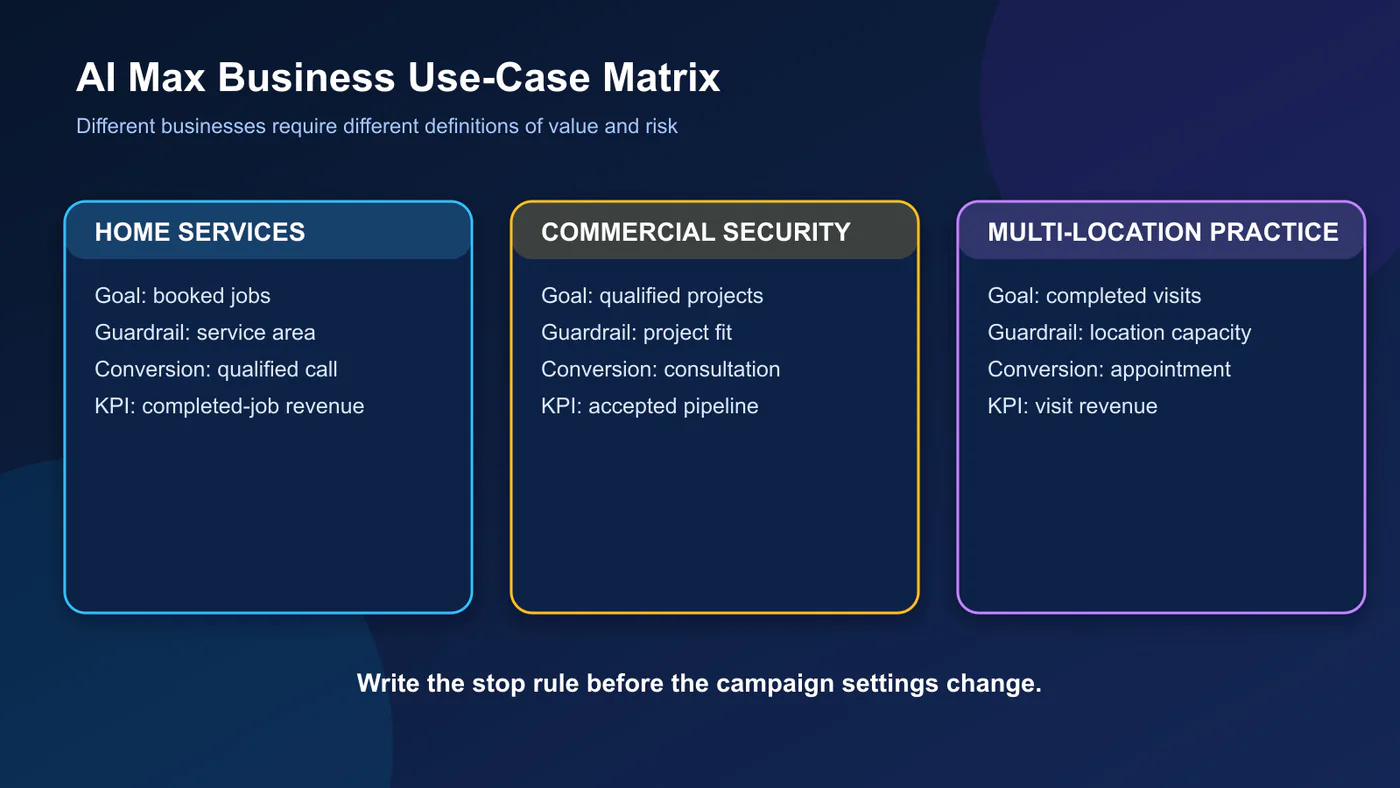
For home services, inspect location intent, tracked calls, booking rate, completed jobs, and revenue by city. For commercial security, capture site count, system type, project timing, qualified consultation, and accepted pipeline. For a multi-location practice, compare appointments, show rate, completed visits, location capacity, and treatment value. A campaign that produces cheaper leads can still be worse for the business if qualification or fulfillment deteriorates.
Audit the Website Before Expanding Automation
AI Max can expose a website problem faster because matching and creative systems rely on the information available to them. Review every eligible landing page for a clear offer, accurate geography, current service details, proof, a usable form, a trackable phone action, and a strong next step. The Atlanta web design service explains how conversion-focused pages connect presentation with business action.
Then trace the measurement handoff. Confirm that forms submit, calls route correctly, duplicate leads are handled, consent requirements are met, CRM stages are consistent, and offline outcomes return to reporting. The Web Conversion IQ framework is designed to connect website behavior with measurable opportunity instead of treating a click or page view as the finish line.
Use a Preflight Checklist and Written Stop Conditions
Inventory affected campaigns; export present settings; review text customization, matching, brands, locations, exclusions, and landing pages; validate primary and secondary conversion actions; test calls and forms; inspect CRM feedback; and define qualified lead and revenue outcomes. Assign an owner to review search terms, assets, destinations, locations, and lead disposition during the transition.
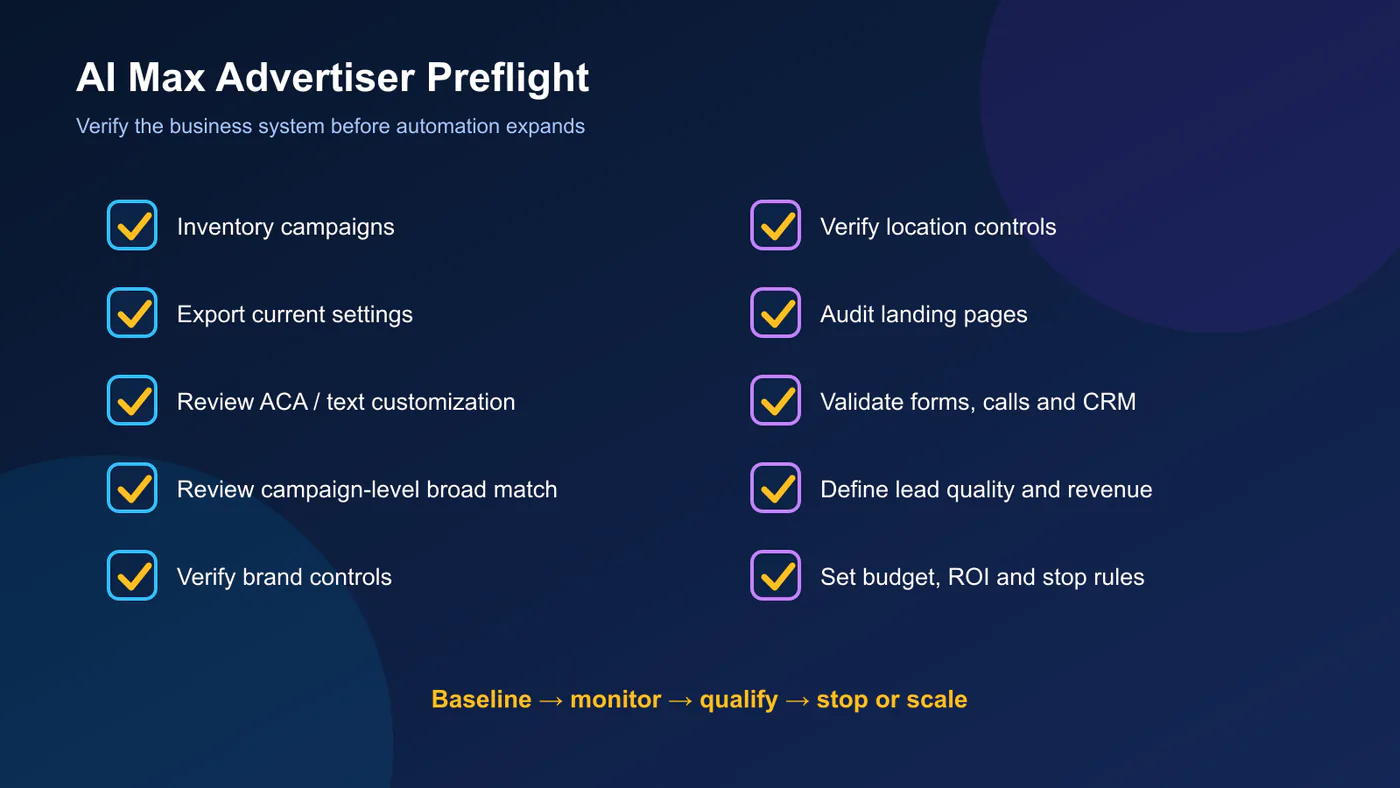
Stop conditions should be specific enough to act on: geographic leakage above an agreed threshold, policy or brand violations, unusable lead volume, broken tracking, budget pacing outside tolerance, or a sustained decline in qualified-opportunity rate. The recent Google Demand Gen business-use-case guide applies the same principle: automation needs a defined customer experience and measurable commercial outcome.
Do Not Let an Auto-Upgrade Make the Business Decision for You
Elite Web Professionals can audit the campaign-to-website journey, conversion tracking, qualification handoff, and decision rules before a transition or controlled AI Max experiment. The purpose is not to reject automation; it is to make its effect visible enough for an informed business decision.
Google AI Max September 2026 changes should push advertisers to verify campaign controls, landing-page quality, conversion tracking, lead qualification, and stop conditions before automation expands. A documented baseline and a revenue-aware measurement plan give the team a fair way to stop, adjust, or scale.
Frequently Asked Questions
Which Google Ads campaigns begin auto-upgrading to AI Max in September 2026?
Google says eligible Search campaigns using Automatically Created Assets, now called text customization, and campaigns using the campaign-level broad match setting begin transitioning in September 2026. Verify the exact notice and settings in each account.
Was the Dynamic Search Ads migration delayed?
Yes. Google says the Dynamic Search Ads sunset and automatic migration to AI Max will begin in February 2027, not September 2026.
What happens to Automatically Created Assets and campaign-level broad match?
Automatically Created Assets are being incorporated as AI Max text customization, while campaign-level broad match is being incorporated into AI Max search-term matching. Google says the relevant transitions begin in September.
What new AI Max A/B tests are rolling out?
Google announced multi-campaign A/B tests that compare budget or ROI-target changes across multiple Search campaigns. The rollout begins in September and may reach accounts gradually.
Can advertisers keep brand and location controls?
Google says selected brand and location settings can remain enabled in AI Max experiments. Advertisers should still monitor actual search terms, locations, assets, and landing pages.
What should a business audit before an AI Max upgrade?
Audit campaign settings, generated assets, brand and location controls, landing pages, conversions, call and form tracking, CRM feedback, lead qualification, revenue measurement, and written stop conditions.
KPIs to Track
- Qualified lead, call, and appointment rate
- Cost per qualified opportunity
- Booking, show, close, and completed-job rate
- Revenue and margin by campaign or experiment arm
- Search-term, location, asset, and landing-page relevance
- Budget pacing and conversion-tracking integrity
What to Watch
- Account-specific transition notices and eligibility
- Changes in labels, settings, and available controls
- The February 2027 Dynamic Search Ads migration timetable
- Search-term quality and landing-page selection after transition
- Differences between platform conversions, CRM outcomes, and revenue
Sources
- Official Source — Google: Dynamic Search Ads and Existing Search Campaign Upgrades to AI Max
- Official Source — Google: New AI Max Testing and Planning Tools
- Official Help — Text Customization in Search Campaigns
- Official Help — Campaign-Level Broad Match in Search Campaigns
- Official Help — Dynamic Search Ads
- Official Help — AI Max for Search Campaigns

 customersupport@advertisingbusiness.org
 (770) 874-6085