 (770) 874-6085


 770-874-6085
Instagram DM automation is becoming easier to build through Vercel’s Chat SDK, but faster automation only helps when it improves lead qualification, response time and human follow-up. A bot that sends a fast but irrelevant answer can damage trust just as quickly as a missed message. The useful goal is a conversation system: one that recognizes why a person wrote, provides an approved next step, and transfers context when judgment is needed.
Quick Answer
Vercel’s Instagram adapter gives developers a way to connect Chat SDK bots to Meta’s Instagram Messaging API. It can support direct messages, media, quick-reply-style cards, link buttons, typing indicators, reactions and story replies. It does not create permission, strategy, CRM ownership or sales judgment. Use it for user-initiated conversations within Meta’s documented 24-hour window, with a defined human handoff.
Key Facts
| Question | Verified answer |
|---|---|
| What changed? | Vercel announced the Chat SDK Instagram adapter on August 19, 2026. |
| Account type | The adapter requires an Instagram Professional Business or Creator account. |
| What it can handle | DMs, media, buttons, reactions, typing indicators and story replies. |
| Timing boundary | Vercel says Meta enforces a 24-hour window after a user’s last message. |
| What remains human | Consent, answer approval, escalation, CRM process and measurement. |
What Vercel Added to Chat SDK
Vercel’s August 19 announcement says its new adapter lets developers build Instagram bots with Chat SDK. The announcement describes sending and receiving direct messages and media, rendering cards as quick replies and link buttons, showing typing indicators, receiving reactions and handling story replies. It also says streamed responses are buffered into one message when the stream completes.
That is meaningful developer plumbing, not a turnkey marketing product. A business still has to configure Meta access, decide which questions the bot may answer, protect customer data, connect records to its CRM and make sure a person can take over. The adapter lowers integration friction; it does not decide what a brand should say.
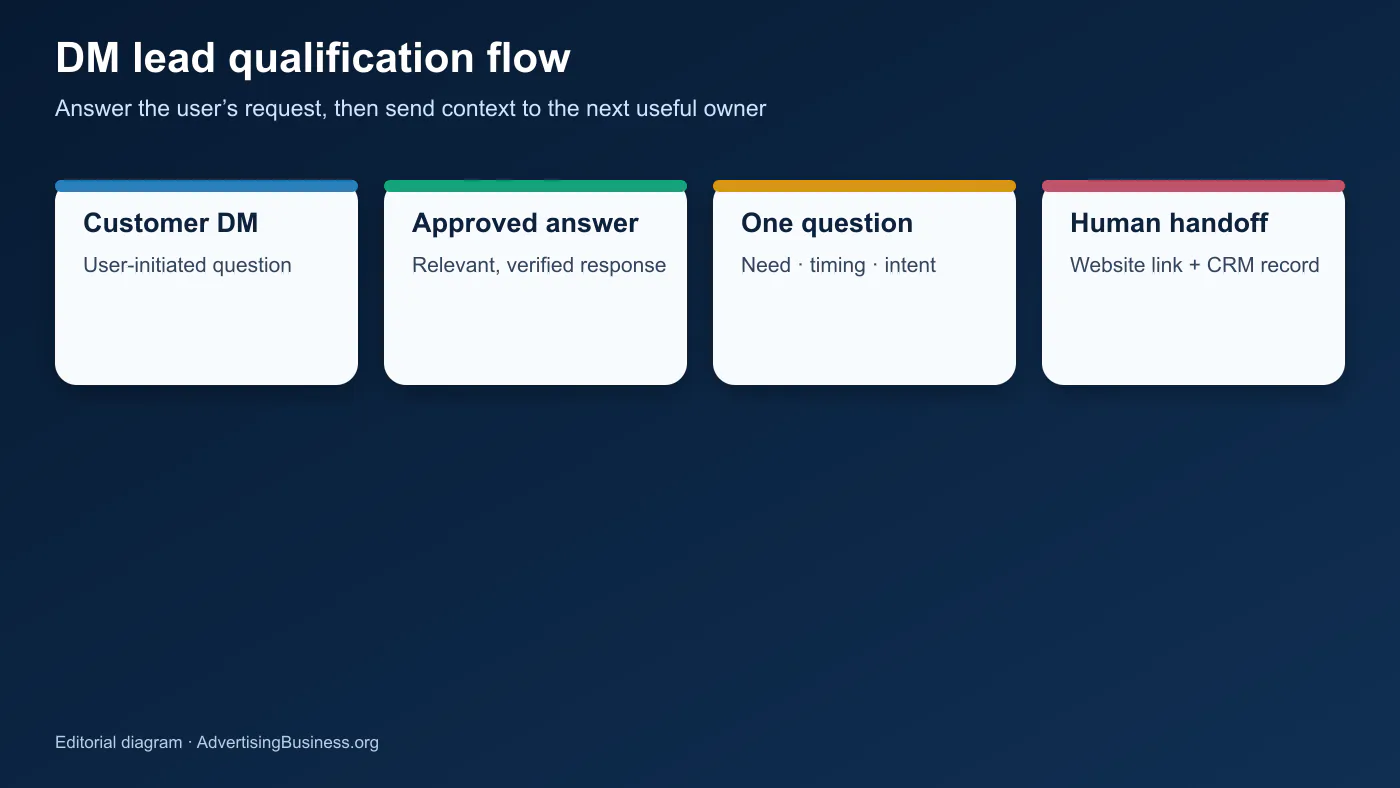
What the Adapter Can—and Cannot—Handle
The adapter can carry a conversation through approved reply patterns. For example, a story reply about a remodeling project can receive a concise acknowledgement, one question about timing, a link to the relevant service page and a choice to speak with a person. The business owns the logic behind every one of those steps.
It cannot validate a custom quote, decide eligibility, interpret a complaint, obtain lawful consent by magic or prove that an answer is current. Define a small approved-answer library and a fallback: “I don’t have a verified answer for that; a team member can help.” The Meta Business Agent lead-response guide is a useful related reminder that fast messaging needs site content and operating rules behind it.
The 24-Hour Messaging Window Changes the Workflow
The messaging window is a workflow constraint, not a creative suggestion. Vercel states that Meta enforces a 24-hour messaging window, allowing bots to reply within one day of the user’s last message. Meta’s Instagram Messaging API documentation is the source of record for the exact integration and policy conditions. Treat the interaction as user-initiated service or follow-up context, not an invitation to scrape prospects and send cold campaigns.
Record the last inbound-message time, design reminders for the human team before the window closes, and stop automated promotional behavior when the permitted context ends. Build an opt-out and a human route into the normal flow. This protects the customer experience even when a platform rule changes.
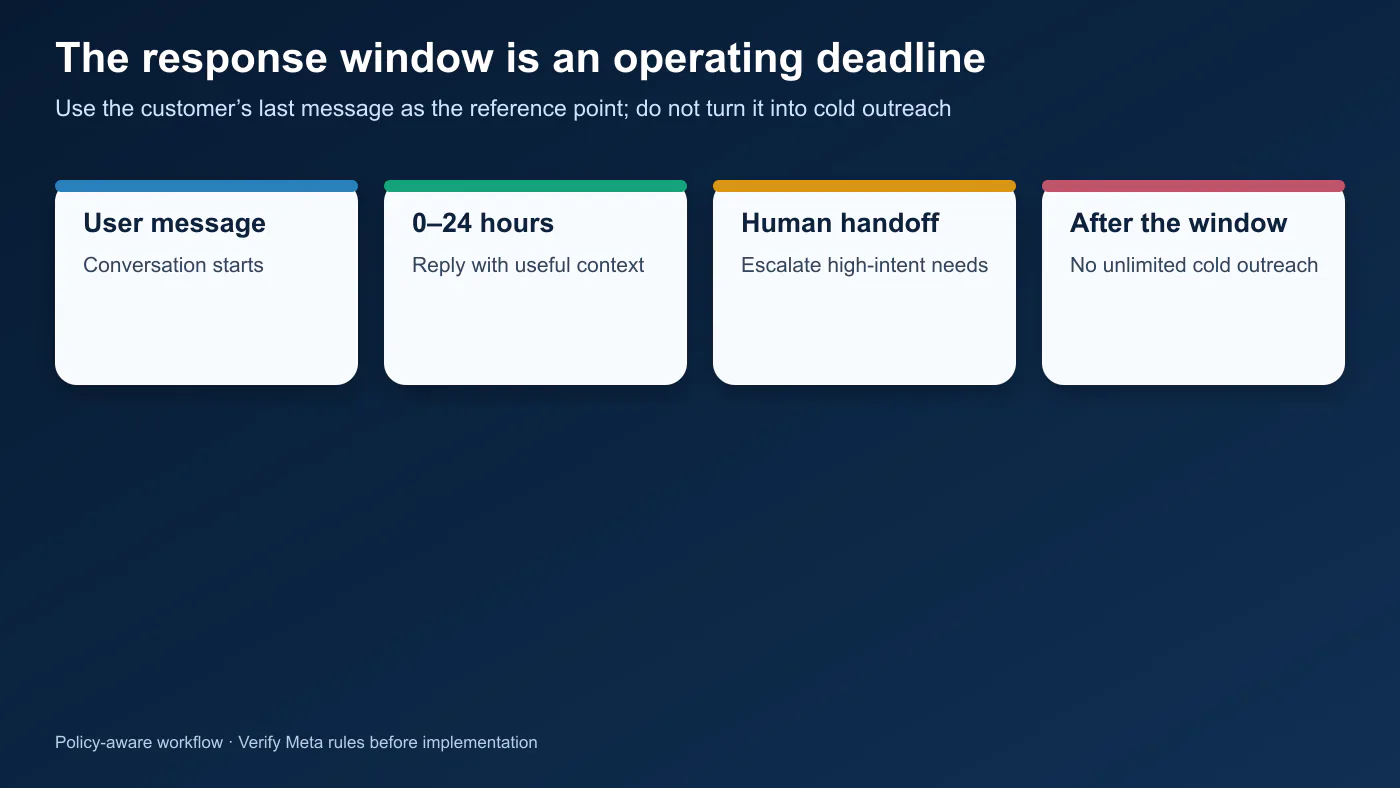
Three Lead-Automation Use Cases
1. Story reply to consultation
A prospective customer replies to a before-and-after story. The bot thanks them, asks whether they are exploring a project or ready to schedule, offers a relevant website page and records the story as the source. A high-intent response creates a human task with the transcript. Measure qualified conversations, speed to human response and booked consultations—not the number of bot messages.
2. Product or service question
A person asks about availability, price range or fit. The bot can provide only reviewed basics, link to the right page, capture the selected need and hand off anything involving custom pricing or advice. The Atlanta web design service page illustrates the kind of clear offer page a DM should support rather than replace.
3. Lead magnet or event registration
A user asks for a checklist or event details. Send the promised resource, explain any follow-up choice, record campaign source and route a high-intent reply into the email, CRM or appointment workflow. Do not treat a resource request as consent for unrelated outreach.
Qualify Without Interrogating the Customer
Ask one question at a time, and ask only questions that change the next useful action. “Are you looking for a project this month or researching options?” is better than a long intake form pasted into a DM. Answer the immediate question before asking for information. Keep sensitive information out of an automated flow wherever practical, and tell the person what happens next.
Know When the Bot Must Hand Off
Escalate immediately when a person asks for a human, sounds frustrated, requests custom pricing, shares sensitive information, is ready to schedule or needs legal, medical, financial or policy judgment. Also hand off when the bot lacks a verified answer. A clean transfer includes the person’s question, declared need, source, timestamps and the answer already provided, so the customer is not asked to repeat themselves.
Connect the Conversation to the Website and CRM
A DM is one touchpoint, not the system of record. Capture a consent-aware contact identifier where appropriate, campaign or story source, intent category, handoff owner, link clicked and outcome. Pass those fields to the CRM with a unique conversation reference. On the website, use focused pages that answer the topic introduced in the DM and give the customer a clear booking, form or phone option.
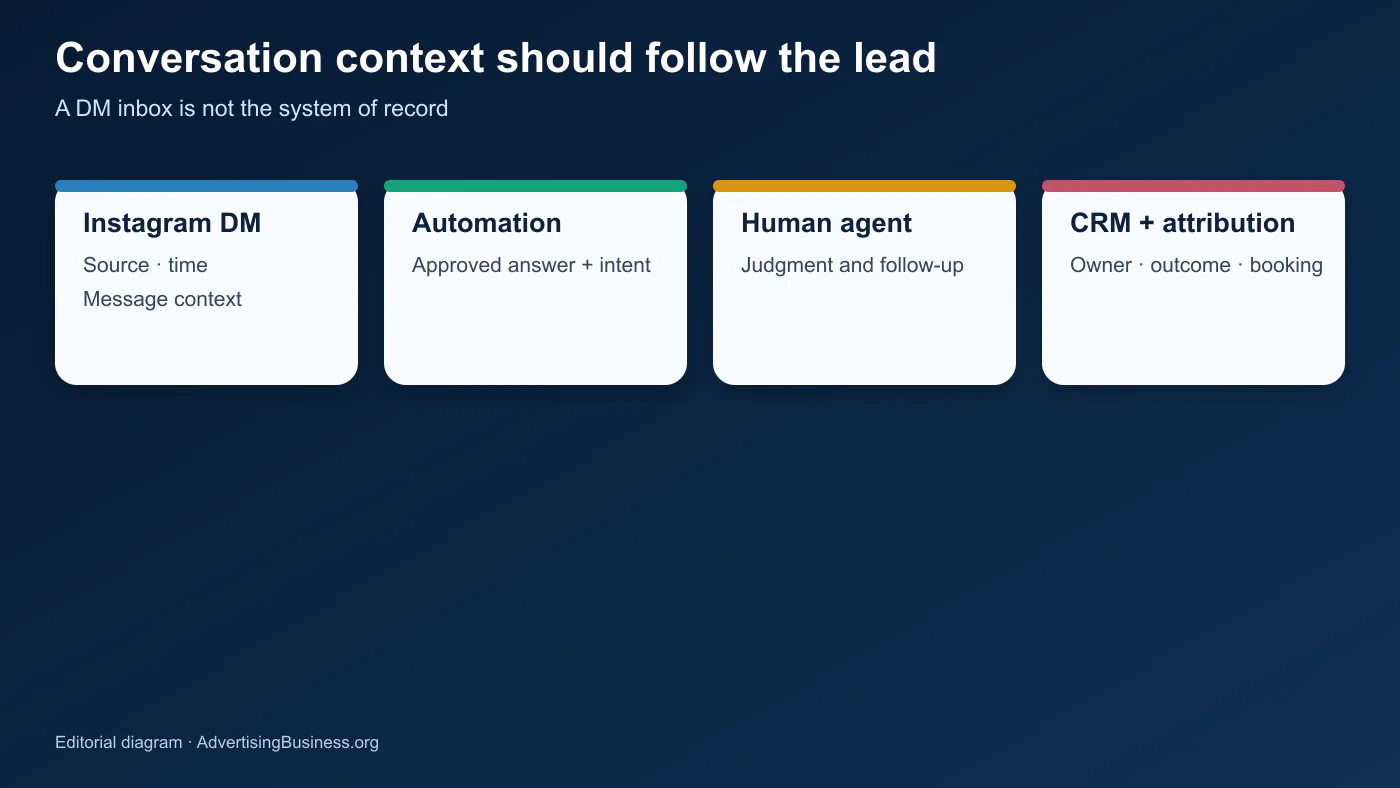
The Line Between Helpful Automation and Spam
Helpful automation responds to a real customer action with an answer relevant to that action. Spam ignores context, repeats itself, pushes promotions into a personal channel and makes it hard to reach a person. The test is simple: would a reasonable recipient understand why this message arrived and have an easy next move? If not, do not automate it.
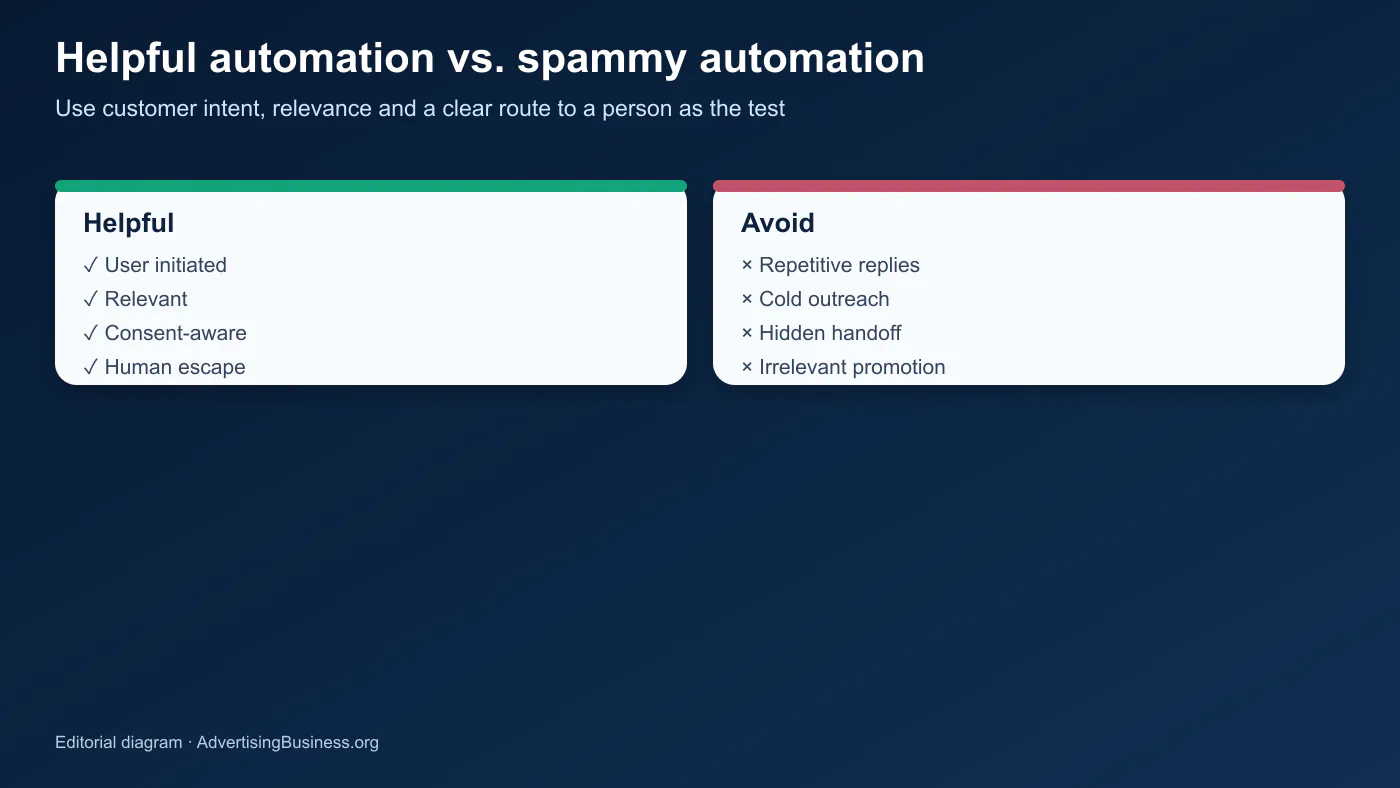
Measure Qualified Conversations, Not Bot Activity
Track qualified DM conversations, median response time, human-handoff rate, booking or form-completion rate, DM-to-CRM match rate, website clicks, complaint rate and influenced pipeline. Review transcript samples for incorrect answers and stalled handoffs. A high reply count with low qualification is not evidence of a healthy lead channel.
Instagram DM automation should shorten the distance between a real customer question and a useful human response—not create another channel for irrelevant messages.
Build a Conversation System, Not a Reply Machine
Elite Web Professionals connects social engagement to Growth Engine Websites: the service pages, qualification paths, CRM signals and human follow-up that help a business be visible, be found and get chosen. A practical implementation review can map approved DM questions to the right website content and measurement plan.
Request a conversation-system review when your team needs a safer route from social inquiry to sales follow-up.
Frequently Asked Questions
What did Vercel add for Instagram bots?
Vercel added an Instagram adapter for Chat SDK. Its announcement says developers can build bots that handle direct messages, media, quick replies, link buttons, typing indicators, reactions and story replies through Meta’s Instagram Messaging API.
Does the Instagram adapter work with personal accounts?
No. Vercel says the adapter requires an Instagram Professional Business or Creator account. Teams should also verify current Meta integration eligibility, access permissions and policy requirements for their exact use case.
What is Instagram’s 24-hour messaging window?
It is the documented period after a user’s last message during which the bot can reply, according to Vercel’s announcement. It does not authorize unlimited outreach or convert a cold prospect into an open marketing channel.
Can a business use a bot to send cold DMs?
No. This framework is for customer-initiated conversations and policy-aware replies, not unsolicited mass or promotional cold DMs. A business should confirm applicable Meta policies before implementing any messaging workflow.
When should an Instagram bot hand the conversation to a person?
It should hand off when a person asks, becomes frustrated, needs a custom price or judgment, shares sensitive information, is ready to act, or receives an answer the bot cannot verify. The handoff should preserve context.
How should Instagram DM leads be tracked?
Track source, intent, response time, owner, link click, handoff and conversion outcome in a consent-aware CRM workflow. Connect the DM to the website path and measure qualified conversations and booked actions, not message volume alone.
KPIs to Track
- Qualified DM conversations and median response time
- Human-handoff and DM-to-CRM match rate
- Bookings, forms, website clicks and influenced pipeline
- Negative response, complaint and failed-answer rate
What to Watch
- Meta eligibility, permissions and messaging-policy changes
- Vercel adapter releases and implementation documentation
- Answer-library review dates and CRM failure handling

 customersupport@advertisingbusiness.org
 (770) 874-6085