 (770) 874-6085


 770-874-6085
Drupal vs Joomla vs Ghost vs Sitecore is the wrong comparison if the only question is “which CMS has more features?” These systems exist for different content operations, team structures and levels of technical governance.
A five-page local business site usually does not need enterprise content infrastructure.
A global organization managing dozens of brands, languages, approval workflows and structured content across channels may find a simple page builder equally inappropriate.
The right CMS reduces the complexity your organization actually has.
The wrong CMS introduces complexity because the software is capable of it.
That distinction is why businesses should start with content operations: who creates content, who approves it, how structured it is, where it must appear, how many sites and languages exist, how often developers are involved, and what integrations or governance rules the organization must enforce.
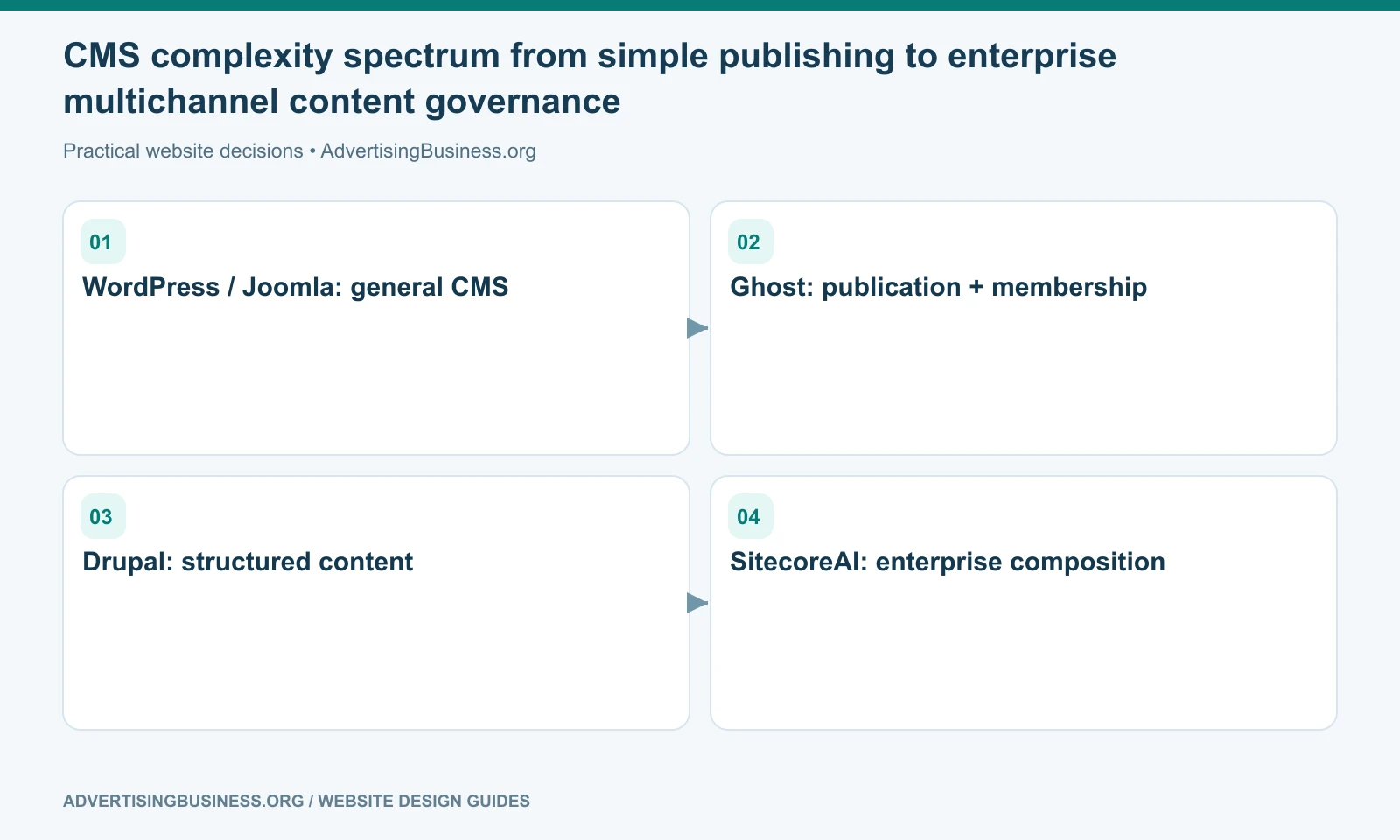
Do not choose enterprise software because it sounds more powerful
“Enterprise-grade” is not a universal quality score.
Enterprise platforms often support requirements a small company does not have: multiple teams and roles, complex workflows, localization, structured content models, headless delivery, advanced security governance, composable architecture, staging across many markets, personalized experiences and extensive integration layers.
Those capabilities can be worth substantial implementation cost when they solve a real operational problem.
Without the problem, they are overhead.
Before selecting any CMS, write the content operating model in plain English. Who publishes? Who approves? How many page types exist? Does content need to be reused in an app or another channel? Are there dozens of sites? Are there regulatory approvals? Does marketing need to publish without developer intervention? Does the company have developers who can maintain the system?
The answers will eliminate more platforms than a feature matrix will.
Drupal: built for structured content, agencies and complex organizations
Drupal has long been associated with complex websites, strong content modeling and developer-led implementation.
Its current direction reinforces that position. Drupal’s June 2026 CMS product strategy explicitly says Drupal CMS is aimed at agencies and professional developers building sites for content creators and marketers. It says Drupal will continue serving enterprise needs while also targeting mid-market organizations and complex organizations with content-management requirements.
The strategy also explicitly states what Drupal CMS is not trying to be: an entry-level website builder competing directly with Wix and Squarespace or a rapid-prototype vibe-coding tool.
That makes Drupal a serious option when the organization needs structured content, multilingual capabilities, governance, extensibility, open-source control and long-term professional development.
It is rarely the platform to choose because a small business owner wants to drag a few sections onto a page this afternoon.
Joomla: a general-purpose open-source CMS with a smaller modern footprint
Joomla remains an active open-source CMS rather than a historical product.
Joomla 6.1 was released April 14, 2026. The release includes a visual workflow editor, media custom-field improvements and other updates aimed at content administration and site building.
Joomla can make sense for organizations that value open-source control, have Joomla expertise available or already operate a mature Joomla site that meets their needs.
The strategic question is ecosystem fit.
Before starting a new build, confirm that the extensions, developers, hosting support, documentation and maintenance capacity your organization needs are readily available. A technically capable CMS can still be the wrong business choice when the company cannot hire or retain the people who know it.
That is true of every open-source platform, but it matters more as the ecosystem becomes more specialized.
Ghost: strongest when the business is fundamentally a publication
Ghost is much easier to understand when you stop comparing it as a generic corporate CMS.
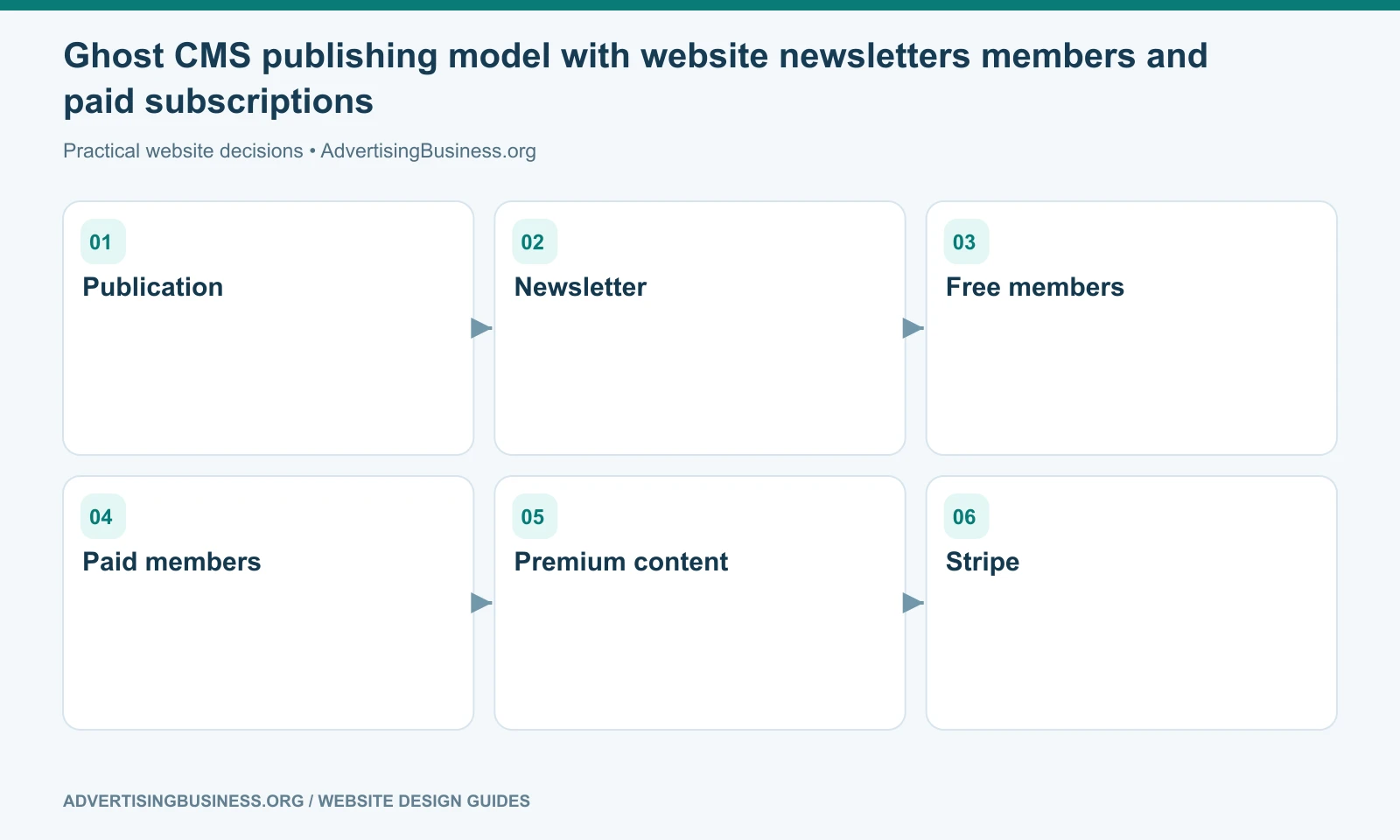
Ghost positions itself around professional publishing: websites, articles, newsletters, memberships and paid subscriptions. Its publisher product is designed for organizations that want to build an audience and run a media or creator business around content.
That makes Ghost compelling for a newsletter-led publication, independent media brand, analyst, creator, membership publication or content business that wants publishing and subscriber economics to be native rather than assembled from multiple plugins.
Ghost can be customized deeply, including custom themes and headless use, but its center of gravity remains publishing.
If the business needs complex service-location architecture, elaborate enterprise workflows, a large ecommerce catalog or dozens of custom application features, choose Ghost only if the publishing model is still the dominant requirement.
Sitecore: an enterprise digital-experience decision, not a small-business CMS upgrade
Sitecore belongs in a different buying conversation.
In 2026, the company’s current terminology is SitecoreAI CMS, formerly XM Cloud. Sitecore describes it as a fully cloud-native SaaS CMS with headless, API-first architecture, visual authoring and AI capabilities inside a larger digital-experience platform.
That architecture is designed for organizations operating substantial digital estates—multiple channels, brands, teams, structured content, personalization, enterprise integrations and formal technology governance.
The benefit is organizational scale.
The cost is that implementation becomes an enterprise program rather than simply “install a CMS.” Architecture, content modeling, migration, component systems, front-end frameworks, roles, integrations and operational adoption all matter.
If a business is comparing Sitecore with a $20/month website builder solely because both can publish web pages, the requirements have not been defined correctly.
Sitecore makes sense when the digital experience itself is enterprise infrastructure.
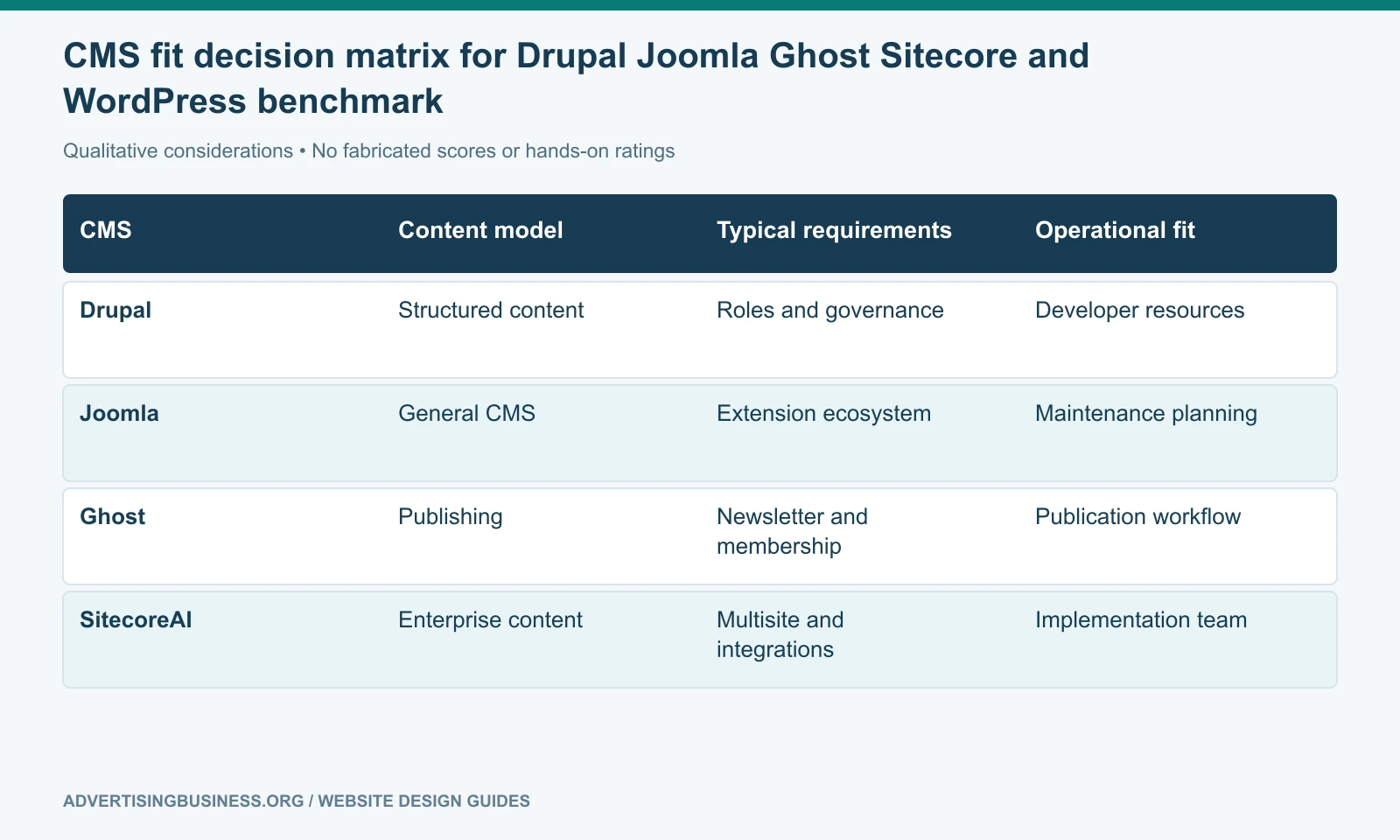
Drupal vs Joomla vs Ghost vs Sitecore at a glance
Drupal vs Joomla vs Ghost vs Sitecore should be decided by the operating problem each platform is optimized to solve.
| Platform | Strong fit | Main question before choosing |
|---|---|---|
| Drupal | Structured, multilingual, complex, professionally built content systems | Do we need this level of content modeling/governance and have Drupal expertise? |
| Joomla | General-purpose open-source CMS | Is the Joomla ecosystem and available talent strong for our requirements? |
| Ghost | Publishing, newsletters, memberships, paid content | Is publishing/subscriber growth the center of the business model? |
| SitecoreAI CMS | Enterprise, multi-channel, headless/composable digital experience | Do our scale, governance, integrations and teams justify enterprise DXP architecture? |
The missing fifth column is often WordPress. For many businesses, WordPress remains the practical middle ground because its ecosystem can support simple marketing sites through large content operations. That does not make it correct for every project; it makes it a useful benchmark against which specialized CMS requirements should be justified.
Migration difficulty is part of the buying decision
A CMS migration is not only copying text.
Content types must map. URLs must be preserved or redirected. Metadata must move. Media must be audited. templates and components must be rebuilt. Forms and integrations need replacements. Roles and workflows must be recreated. Analytics and tracking must be validated. Search engines need consistent canonical and redirect signals.
Enterprise migrations add even more governance.
Sitecore’s current migration material explicitly treats migration as content-structure and component work rather than a simple lift-and-shift. Drupal’s product strategy emphasizes long-term content governance. Ghost centers publisher data and member/subscription workflows. Joomla sites may rely on extensions whose equivalents must be evaluated.
Therefore, evaluate exit complexity before selecting the CMS.
The more proprietary the implementation, the more important the migration plan becomes. The more modular the open-source stack, the more important dependency and update management becomes.
Security is an operating process, not a platform slogan
Every CMS can be implemented badly.
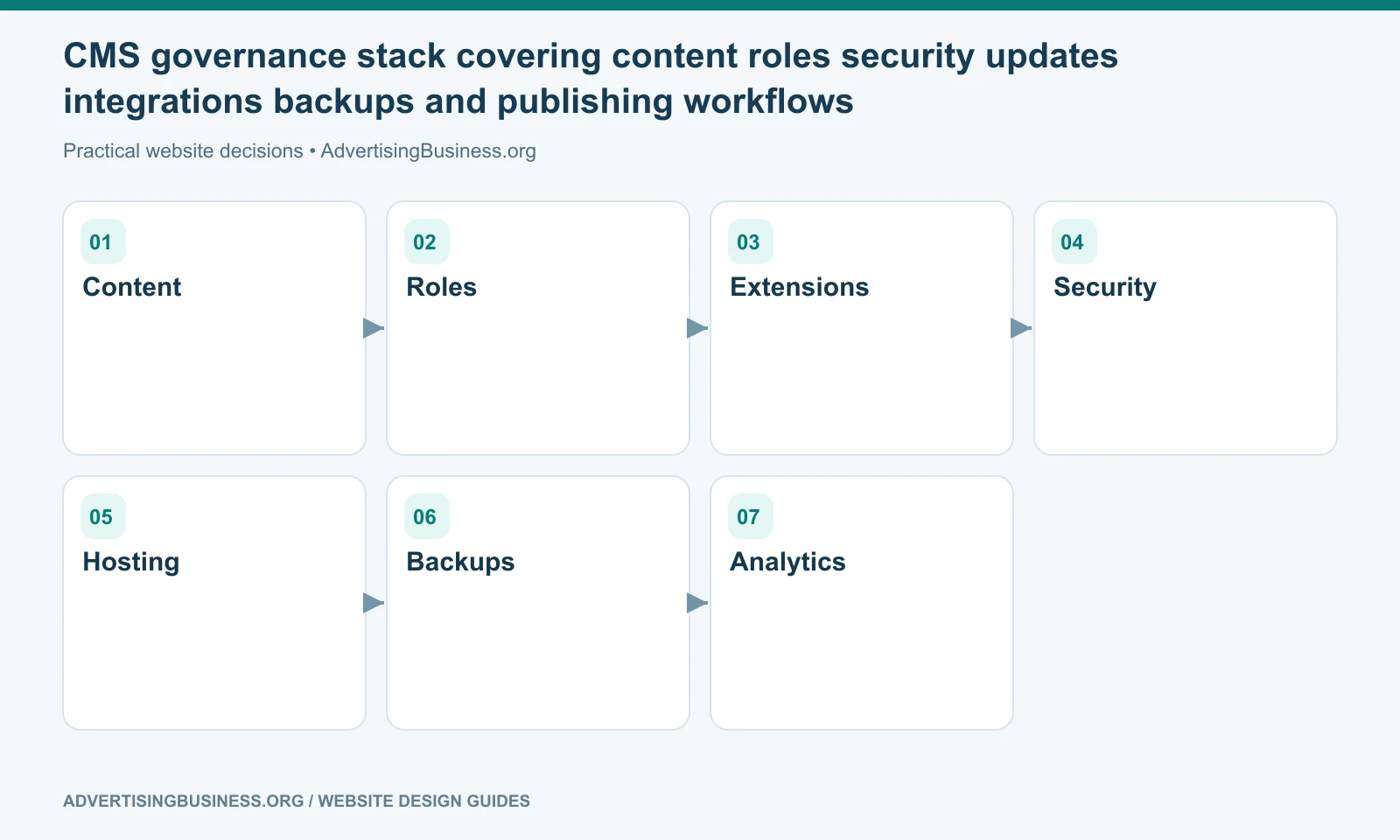
Open-source software requires disciplined patching, dependency management, backups, permissions and hosting security. SaaS moves more infrastructure responsibility to the vendor but still requires account security, access governance, integration review and safe publishing practices.
Enterprise platforms add organizational controls but also create larger implementations with more interfaces and permissions to govern.
Ask who owns security updates, vulnerability response, backups, staging, disaster recovery, user access, third-party code review and incident response. A platform name is not a security plan.
Choose the CMS that removes complexity instead of advertising it
A specialized platform earns its cost when its specialization is the reason the organization can operate more effectively.
Ghost removes friction from publisher memberships and newsletters. Drupal gives professional teams an open, structured framework for complex content. Joomla remains a capable open-source CMS for organizations with the right ecosystem fit. SitecoreAI CMS addresses enterprise digital-experience infrastructure.
If those problems do not exist, do not manufacture them in order to justify the software.
Elite Web Professionals can help separate website requirements from platform assumptions before a redesign or migration. Review our Website Design service or contact us with the current CMS, page count, integrations and publishing workflow.
Drupal vs Joomla vs Ghost vs Sitecore becomes a useful comparison only after the business defines what its content system must govern. Pick the platform whose complexity solves your complexity—and no more.
Frequently asked questions
Is Drupal only for enterprise websites?
No. Drupal’s 2026 strategy also targets mid-market and complex organizations, but it explicitly positions agencies and professional developers as the primary builders rather than competing as an entry-level DIY website builder.
Is Joomla still actively maintained in 2026?
Yes. Joomla 6.1 was released April 14, 2026 with new workflow and media features among its updates.
Is Ghost a full CMS or just a newsletter tool?
Ghost is a full publishing platform with website design, web publishing, newsletters, memberships and paid subscriptions. Its strongest fit is businesses where publishing and audience ownership are central.
What is XM Cloud called now?
Sitecore’s current documentation says SitecoreAI CMS is the current product name for what was formerly XM Cloud.
Sources
- Official Drupal 2026 strategy: https://www.drupal.org/about/initiatives/cms/strategy-2026
- Official Joomla 6.1 release: https://www.joomla.org/announcements/release-news/joomla-6-1-is-here.html
- Official Ghost publisher platform: https://ghost.org/publishers/
- Official SitecoreAI CMS overview: https://www.sitecore.com/resources/insights/development/migrating-to-sitecoreai-cms
- Sitecore developer portal: https://developers.sitecore.com/sitecoreai/capabilities/cms
- https://www.advertisingbusiness.org/wordpress-7-1-marketers-seo-competitors/

 customersupport@advertisingbusiness.org
 (770) 874-6085