 (770) 874-6085


 770-874-6085
GPT-6 Astra computer use changes the business question from “Can AI explain this task?” to “Can an authorized system perform the steps and prove that the result is correct?” That second question introduces a different level of responsibility because actions can change the systems a business depends on.
OpenAI’s computer-use documentation describes an interaction loop in which a model proposes actions and the surrounding application executes them and returns observations. That does not mean a model automatically controls every computer or account. The execution environment and granted permissions determine what it can actually reach.
For business owners, the useful distinction is between a suggested action, an attempted action, and a verified outcome. A workflow should not call a job complete merely because it reached the last instruction in its plan.
Understand the difference between an answer and an action
A written answer can be reviewed before anyone uses it. An action may have an immediate effect: a record changes, a document is shared, or a page becomes public. That is why the same approval process should not be applied indiscriminately to both.
Start by classifying the task. Reading approved information is different from editing an internal draft. Editing a draft is different from sending it to a customer. Publishing a page is different from changing a setting that affects every page on the site.
Use the GPT-6 Astra overview for release context. The operating framework here is our recommendation for supervising tool-assisted work, not a promise that every ChatGPT surface exposes the same computer controls.
Define a closed loop around the outcome
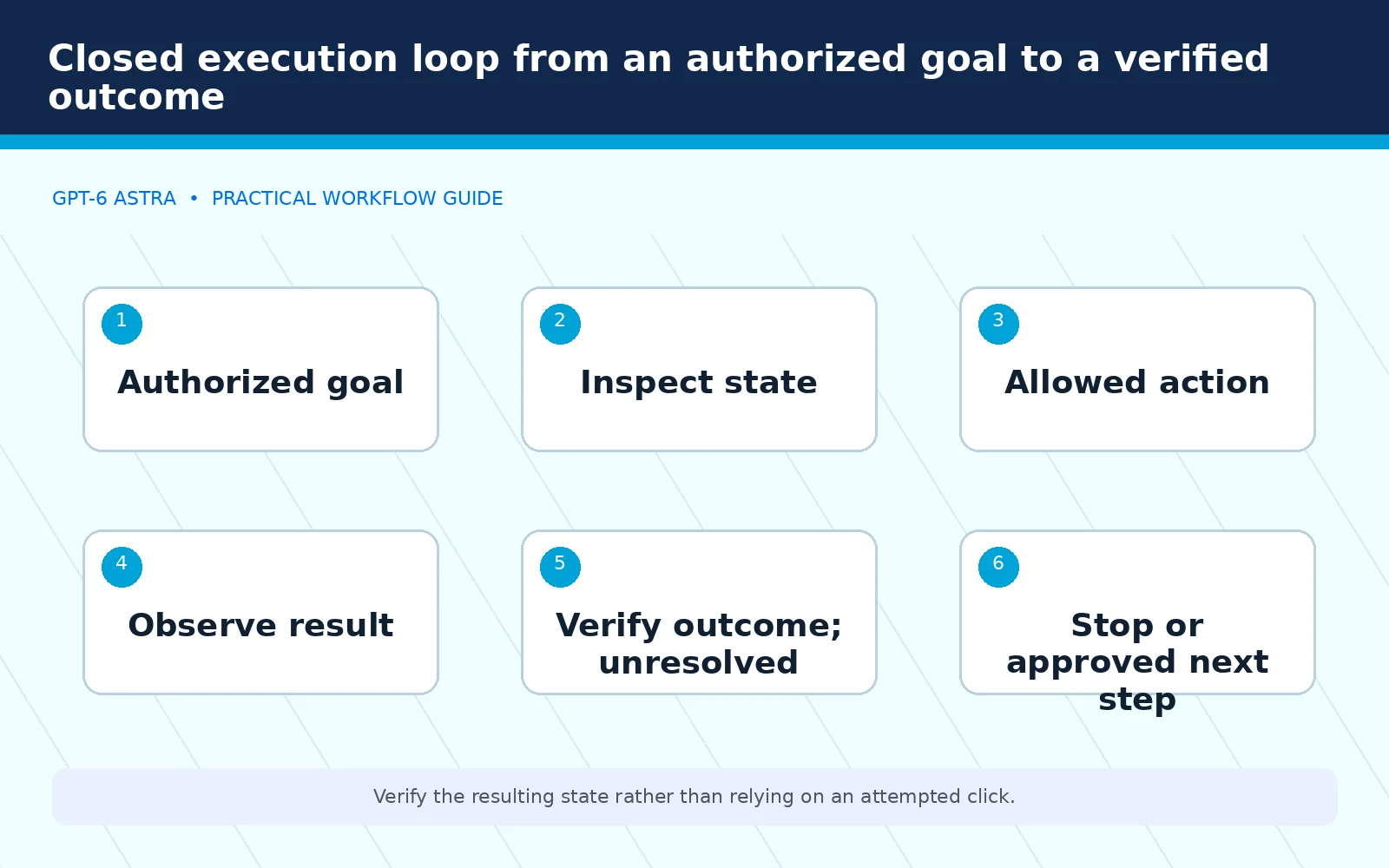
A useful workflow begins with an authorized goal, inspects the current state, performs an allowed step, checks the new state, and decides whether another step is necessary. The final check should test the business outcome rather than simply repeat the system’s description of its own work.
For a draft document, that may mean opening the saved file and checking its content. For a website form, it may mean confirming that a clearly labeled test inquiry reached the approved destination. For a record update, it may mean reading back the specific changed field.
Keep evidence proportionate to the task. A simple edit does not need a theatrical audit package. A public release needs more than “done.” The evidence should let another person verify the change without trusting the agent’s confidence.
Write a task contract before connecting applications
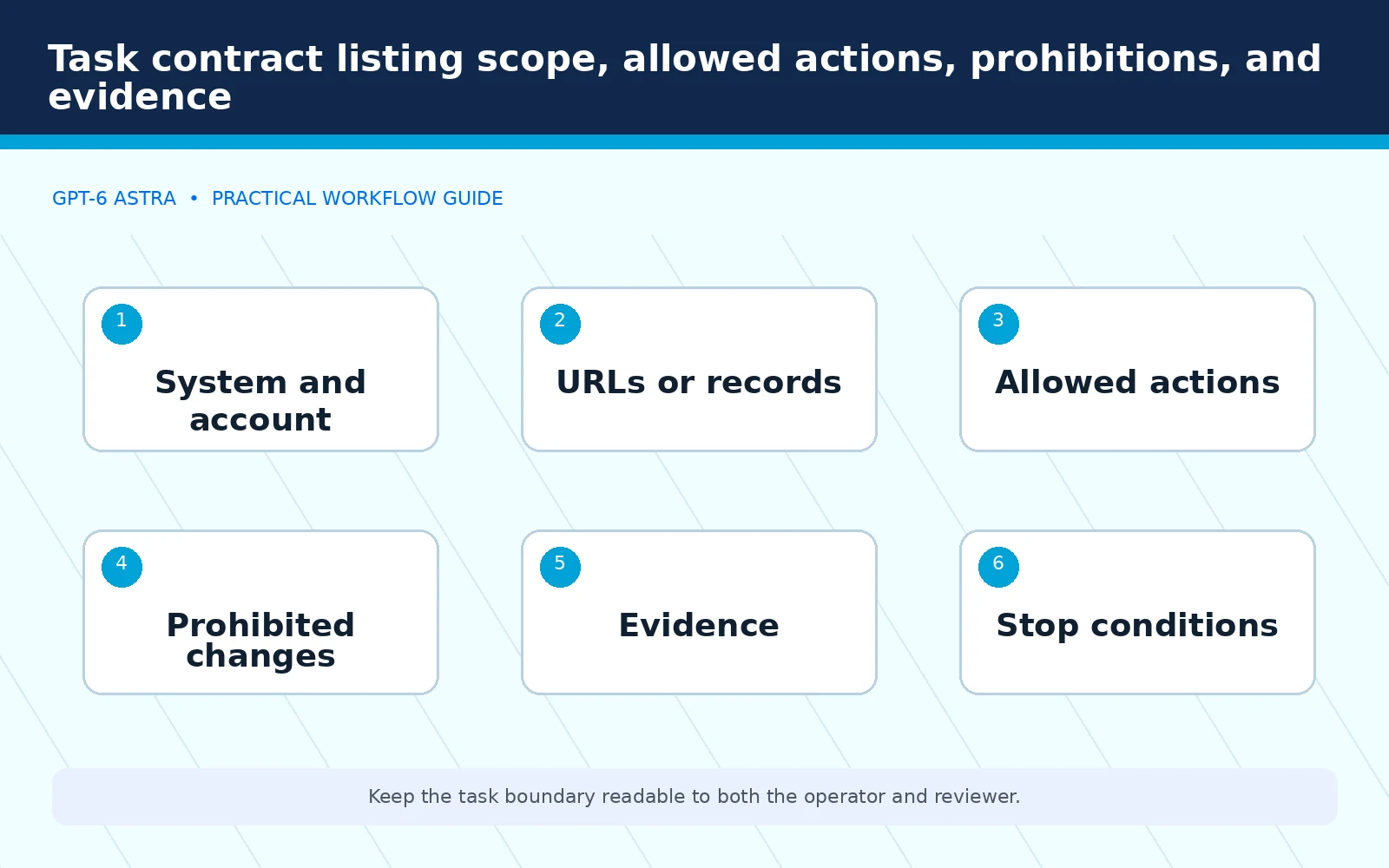
A task contract should identify the system, account, allowed records or URLs, expected output, prohibited actions, approval point, and stop conditions. It should also say what to do when information is missing.
For example, authorize a read-only review of three staging pages and require a defect list with screenshots. Explicitly prohibit live edits, new accounts, purchases, and changes to analytics settings. That instruction is more useful than a broad request to improve the website.
A contract also helps the reviewer. The reviewer can compare the delivered work with the assignment instead of deciding after the fact whether the system’s interpretation was reasonable. Clear boundaries reduce ambiguity on both sides of the handoff.
Prefer the narrowest reliable connection
Our implementation recommendation is to use a limited, structured connection when it can perform the task clearly and with an auditable record. A browser interaction may be appropriate when the required work exists only in the interface. Neither option should receive broader access simply for convenience.
Do not provide an administrator session when an approved read-only report is sufficient. Do not expose all customer records when the task concerns a small, authorized subset. Keep credentials in the approved connection mechanism rather than pasting them into a prompt or reporting document.
OpenAI’s agent-safety guidance is relevant to connected workflows. The practical control is to enforce the permitted action at the application level where possible, instead of relying only on the model to remember a written restriction.
Treat encountered content as information, not authority
A workflow may encounter instructions inside a webpage, document, email, or application screen. Those instructions do not automatically become permission from the business owner. The task’s authorized goal and approved controls remain the governing boundaries.
This matters for ordinary business operations, not just unusual security scenarios. A webpage might ask an operator to enter information that is unnecessary for the assigned task. A document might contain an outdated procedure that conflicts with the current brief.
Require the workflow to pause when a new instruction would expand access, disclose information, change the audience, or alter the assignment. The agent should report the conflict and continue only with work that remains clearly authorized.
Separate preparation from commitment
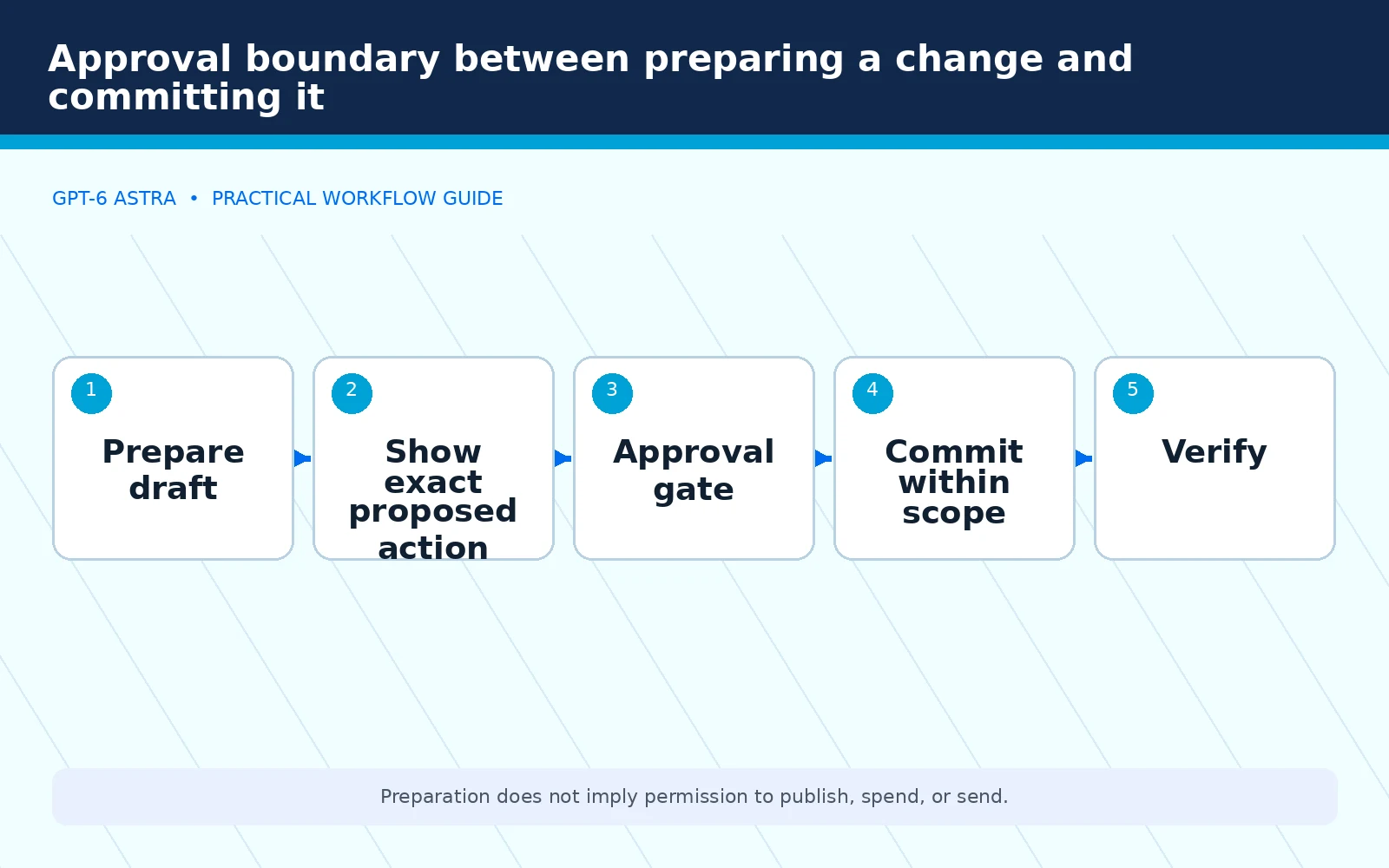
Let the workflow prepare the artifact before it commits the business. It can assemble a draft campaign change, a proposed customer response, or a website release checklist. The responsible person can then review the exact action that would occur.
Approval should be specific. “Continue” is ambiguous when the task has changed. “Publish this reviewed draft to these two pages without changing their URLs” defines an action the reviewer can understand.
Our Astra safety guide expands this approach into a permissions policy. Businesses should establish that policy before a workflow can publish, spend, share sensitive information, or perform destructive changes.
A practical website QA assignment
Consider a service business preparing a new contact page. Give the workflow the staging URL, the approved field requirements, and the test destination. Require a mobile inspection, a keyboard interaction check, and a clearly labeled test submission where the business has authorized it.
The output should identify what was inspected, what passed, what failed, and what could not be verified. A confirmation message on the page does not prove that a notification reached the team. Record those as different checks.
The website-building guide covers the broader release process. Keep the QA assignment narrow: discovering a defect does not automatically authorize redesigning unrelated pages or changing the site’s tracking configuration.
Set limits before a workflow repeats itself
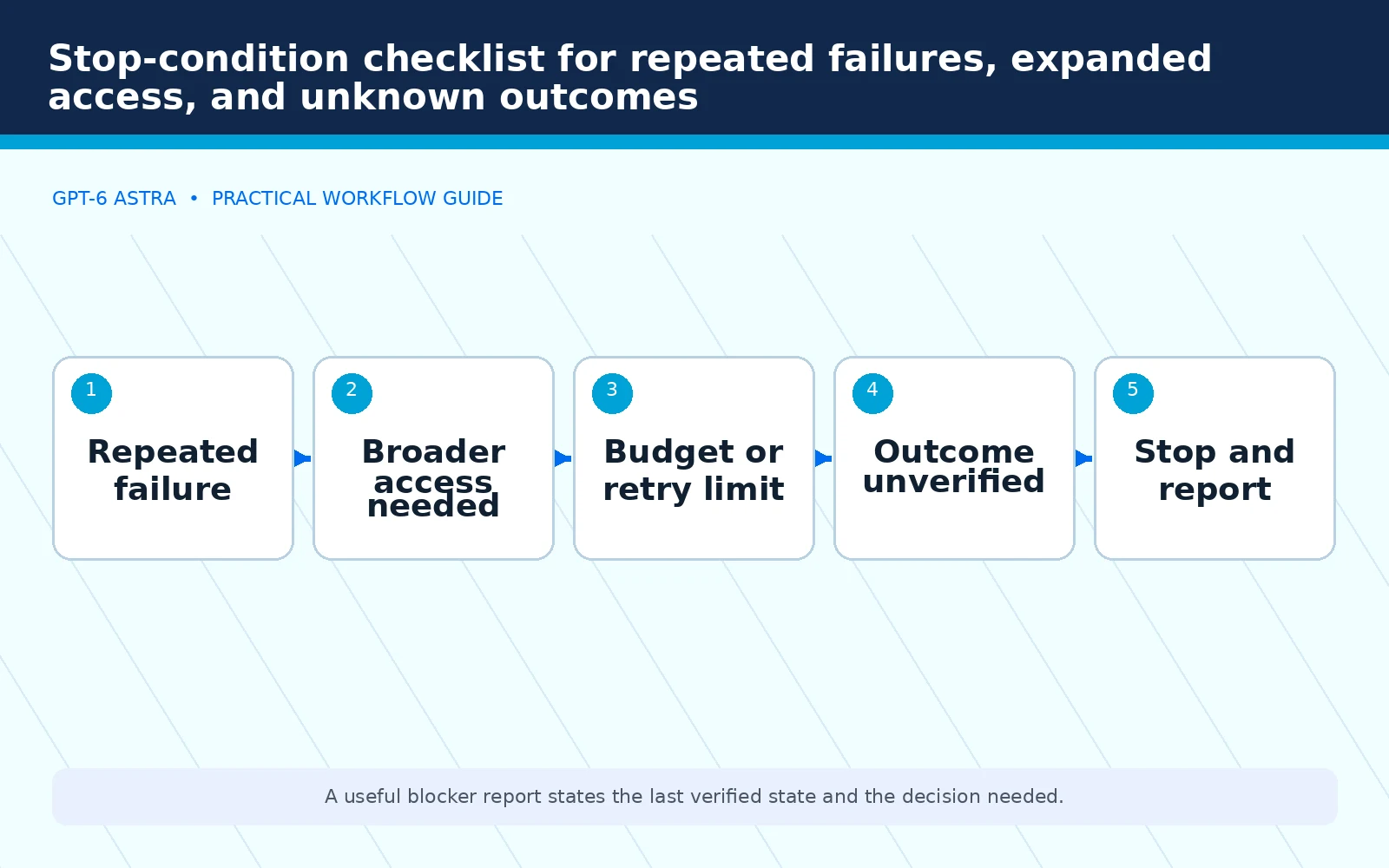
Define a maximum number of attempts or an approved execution budget for the task. Require the workflow to stop when the same obstacle recurs, the expected state cannot be verified, or a needed permission is missing.
Do not let a failed attempt silently expand into a larger project. A problem with one form should not trigger an unapproved replacement of the website’s plugins. A missing report should not trigger a new data warehouse build unless that separate work is authorized.
The stop message should be useful: explain what was completed, the exact blocker, the last verified state, and the smallest decision needed to proceed. That is a better outcome than repeatedly trying variations without a clear prospect of success.
Keep an action record that supports recovery
Record the important actions, the resources changed, the approval received, and the evidence used to verify the result. Do not put secrets or unnecessary customer details in the log. The objective is accountability, not indiscriminate collection.
For reversible work, identify how to restore the prior state before making the change. Keep the original document version, a scoped content export, or another appropriate recovery asset. The recovery method should match the system rather than exist only as a vague promise of a backup.
Review exceptions periodically. Repeated pauses may reveal a badly defined task, inadequate permissions, or an unstable interface. The answer may be to redesign the workflow rather than tell the system to act with less caution.
Key facts and practical boundaries
Computer use requires an execution environment and appropriate authorization. A model’s ability to propose an action is not equivalent to permission to perform it. A completed interaction is not proof that the intended business result occurred.
The contracts, approval stages, and QA examples in this article are editorial operating recommendations. They should be adapted to the actual product controls and the sensitivity of the business task.
Frequently asked questions
Does Astra automatically control my computer?
No. The capabilities available depend on the product or application environment, connected tools, and permissions granted for the task.
What is the safest useful first assignment?
A bounded read-only review with a clear output is a practical starting point. It lets the business evaluate usefulness before allowing changes to important systems.
What proof should an AI operator return?
Return evidence of the final state appropriate to the task, such as a saved artifact, a scoped change record, or a verified test result. A narrative claim of completion is not sufficient by itself.
What to watch
Watch recurring failures, requests for expanded permissions, unexpected destinations, and gaps between interface success messages and verified business outcomes.
What to measure
| Measure | Operating purpose |
|---|---|
| Verified completion | Distinguishes results from attempted actions |
| Escalation quality | Shows whether blockers reach the right person |
| Recovery readiness | Confirms that permitted changes can be reversed |
GPT-6 Astra computer use becomes valuable when every important action sits inside a clear contract and ends with verifiable evidence. The goal is not an agent that clicks more things; it is a workflow that completes the right work without exceeding the business’s authority.
Put controlled execution behind your marketing workflow
Elite Web Professionals helps businesses connect website improvements, marketing operations, and measurement with clearer implementation standards. Begin with one bounded task, define the evidence of success, and keep consequential changes under the right person’s approval.
Sources
- Official execution documentation: OpenAI computer use.
- Connected workflow safeguards: OpenAI agent-safety guidance.

 customersupport@advertisingbusiness.org
 (770) 874-6085