 (770) 874-6085


 770-874-6085
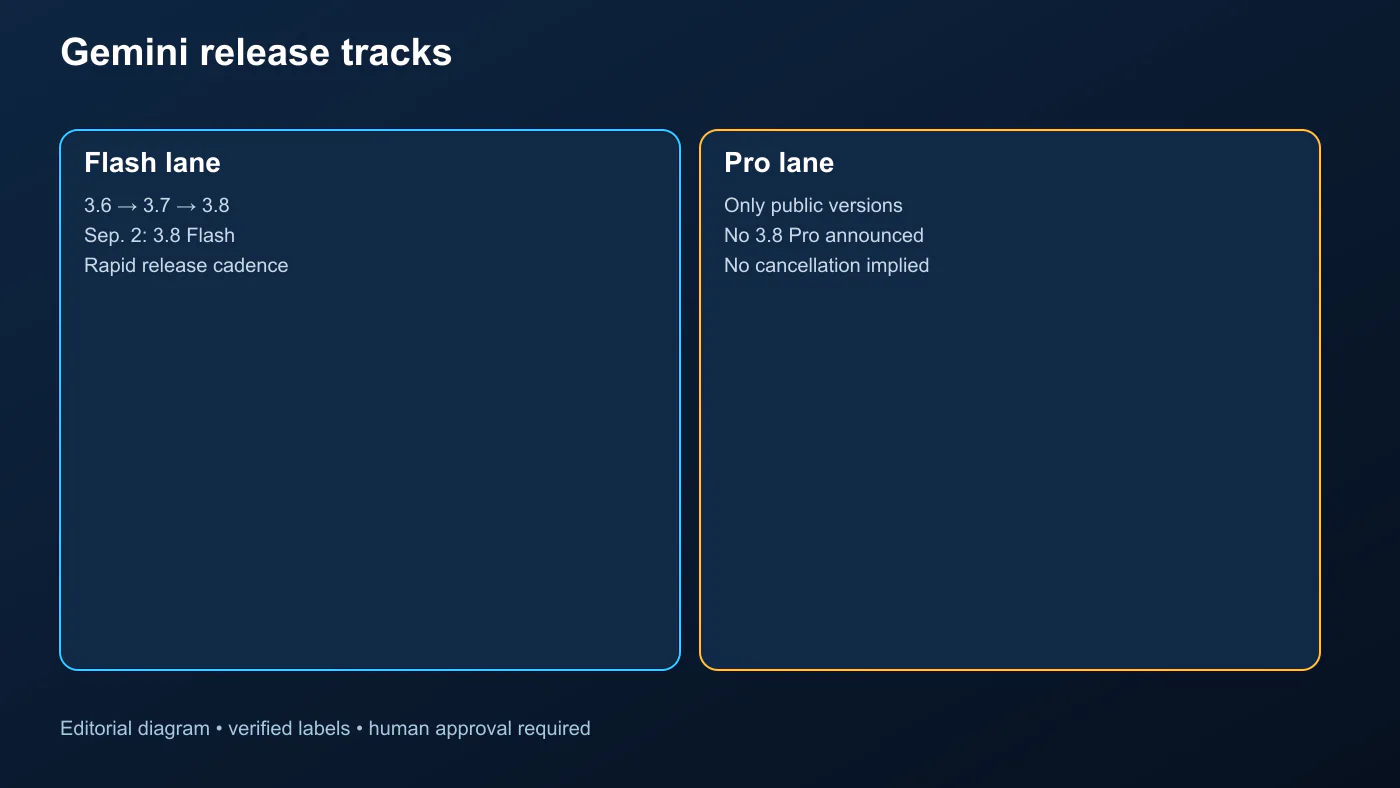
Gemini 3.8 Flash is Google’s newest low-cost model for reasoning, coding, and agent workflows—but its release raises an obvious question: where is Gemini 3.8 Pro?
Google’s September 2 release answers the first part clearly and leaves the second unanswered. The practical takeaway for marketers is not to guess at a roadmap. It is to use the released model for contained, evidence-led work, then measure correction time before expanding access.
Quick Answer: What Is Gemini 3.8 Flash?
Gemini 3.8 Flash is Google’s current high-capability Flash model, positioned for long-horizon engineering, agents, and complex workflows at an introductory low token price. Google introduced it with restricted-access Flash Cyber, but did not announce a Gemini 3.8 Pro or explain that absence. That makes any product-roadmap answer theory rather than fact.
What Google Actually Released
Google says this is its “most intelligent workhorse model,” its third Flash release in six weeks, and a model that “works harder” across software engineering, agentic tasks, and critical multi-step reasoning. The official announcement is the primary source for the release and cadence.
| Confirmed fact | Current official detail |
|---|---|
| Release | September 2, 2026 |
| Inputs | Text, image, video, audio, PDF |
| Output | Text; 65,536-token maximum |
| Context | 1,048,576 input tokens |
| Intro price | $0.75 input / $3.75 output per MTok through Dec. 31, 2026 |
| Cyber variant | Trusted defenders in Fairwind only |
The model page lists caching, code execution, function calling, Search and Maps grounding, file search, URL context, structured outputs, and low/medium/high thinking; computer use remains Preview. Consumer and business availability depends on the product, plan, connection, and permissions.
Why Is There No Gemini 3.8 Pro?
Google has not stated why there is no Gemini 3.8 Pro. The announcement describes two 3.8 variants—Flash and restricted Flash Cyber—without a direct reason for a missing Pro. A missing announcement is not evidence of cancellation, delay, or a Gemini 4 schedule.
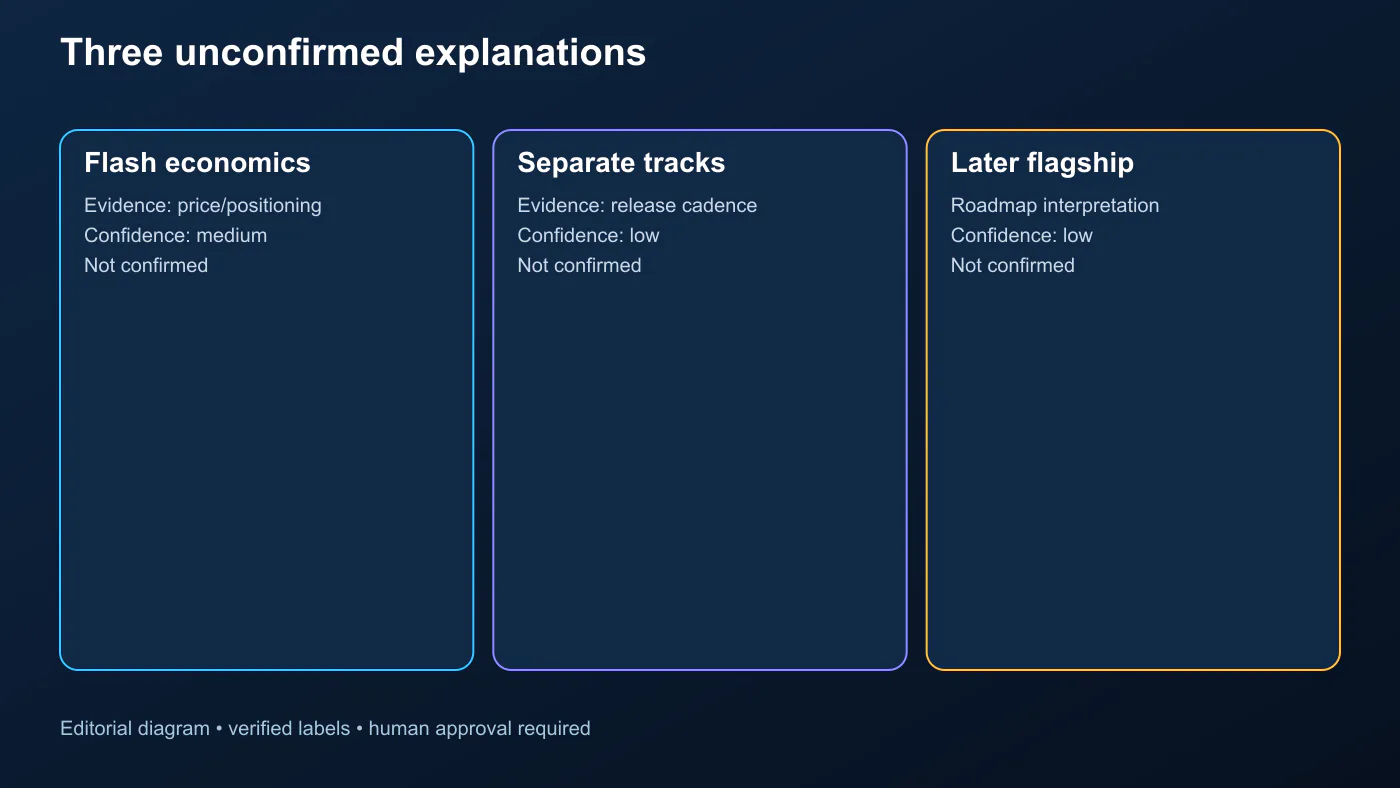
Theory 1: Pro-Level Capability at Flash Economics
Theory, medium confidence: Google may be moving more capability toward Flash economics. The evidence is Google’s performance-and-price positioning, not a statement that Flash replaces Pro.
Theory 2: Flash and Pro May Be Separate Release Tracks
Theory, low confidence: Flash and Pro numbering may move independently. Release cadence supports the possibility, but Google has not documented a shared versioning rule.
Theory 3: Google May Be Saving the Flagship Jump for Later
Roadmap interpretation, low confidence: Google could reserve a larger flagship step for a later Pro or Gemini 4. There is no official confirmation of either plan.
Why Flash Could Matter More to Marketers Than Another Pro
Low cost can matter when the work is repeatable and reviewable. Google’s pricing page lists $0.75/$3.75 per million input/output tokens through December 31, then $1.50/$7.50 from January 1, 2027. Token price is not total cost: a cheap draft that needs extensive factual repair is expensive.
Why Gemini Sometimes Creates More Work
A wrong answer creates rework, and that is a model risk rather than a user failure. Stale sources, ambiguous instructions, incomplete access, and plausible unsupported claims can all enter a marketing deliverable. Search grounding can improve current-fact research, but it is not permission to accept a claim without inspecting its cited source.
The Better Way to Think About Gemini
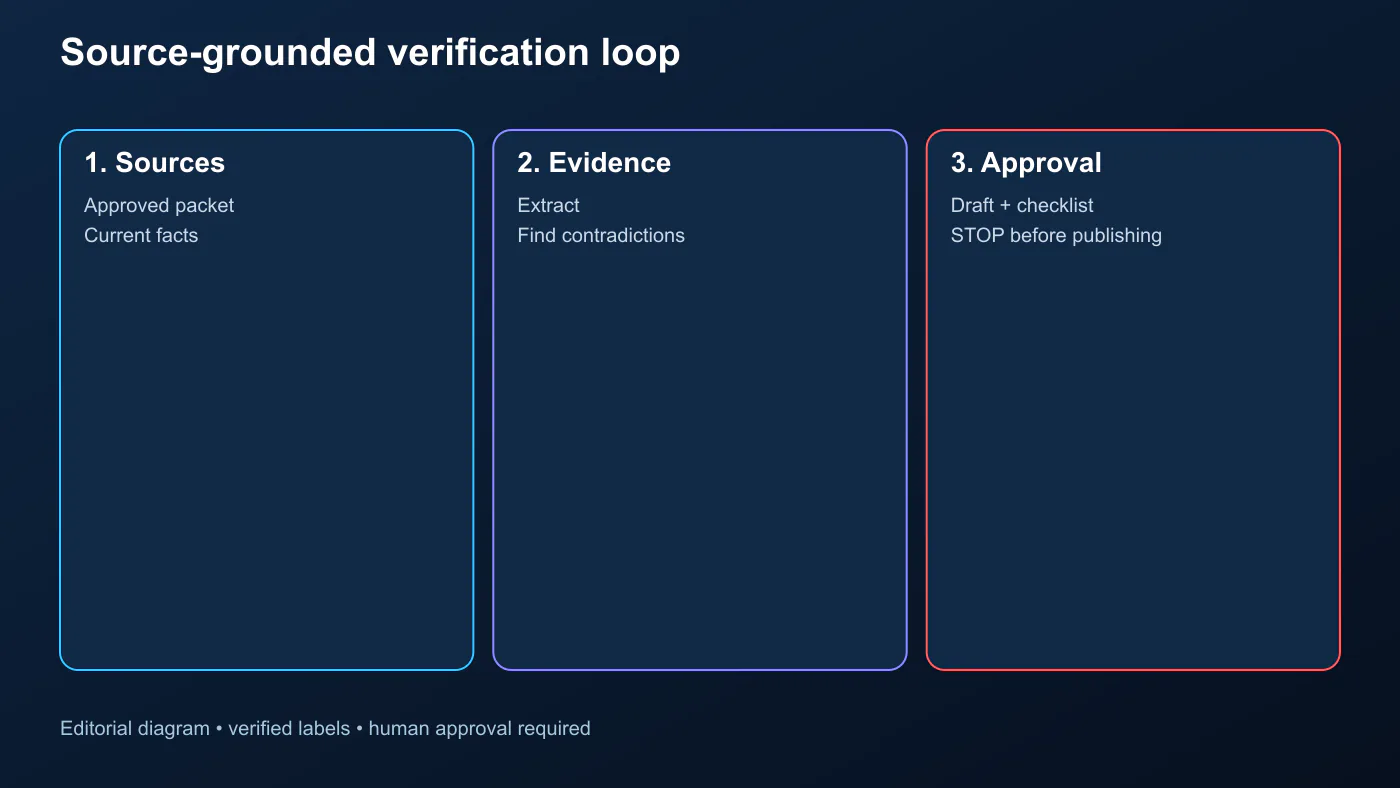
Treat Gemini as a bounded Google-data operator and multimodal processor, not an independent publisher. Keep extraction, contradiction review, strategy, drafting, and approval as separate stages. Never let it independently publish, change budgets, or edit sensitive profile fields.
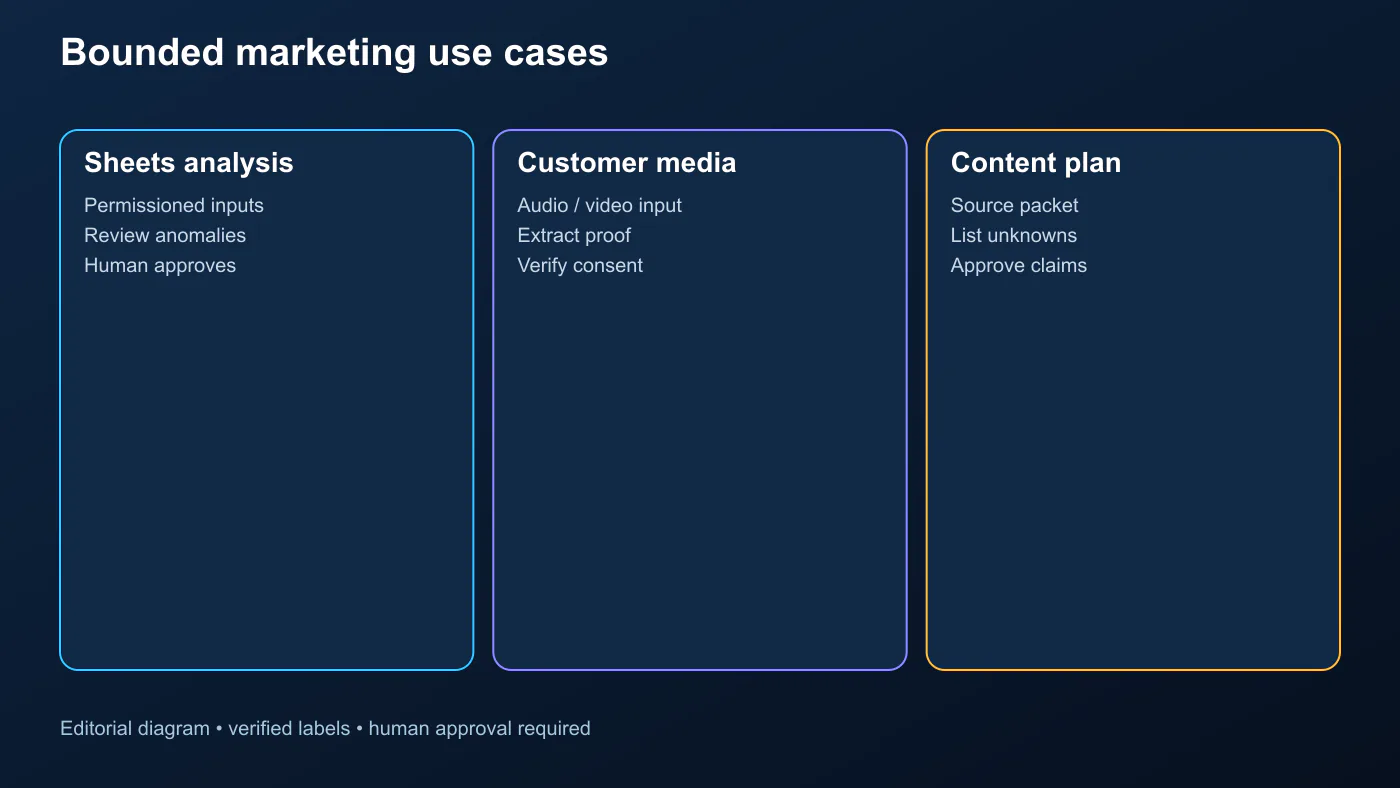
Use Case 1: Campaign and Lead Analysis in Sheets
Use it to summarize a permissioned export, then require a reviewer to check every recommendation against the source rows. It can identify anomalies and build a decision brief; a marketer must approve budget, targeting, and attribution conclusions.
Use Case 2: Turn Video and Audio Into a Website Case Study
Use multimodal inputs to extract candidate proof from customer media, then obtain approval and verify wording. Do not treat a transcript as permission to publish a testimonial or sensitive customer detail.
Use Case 3: Turn Existing Business Material Into a Content Plan
Use a defined packet of pages, FAQs, calls, and sales notes to produce a traceable content outline. Require source references, gaps, and an unknowns list before a writer turns it into claims.
A Better Gemini Prompt and Verification Loop
Ask for proof before polish. “Use only the attached sources and cited grounded results. Return: (1) an evidence table with source links, (2) missing information, (3) recommendations marked as recommendations, (4) a draft, (5) a verification checklist, and (6) every claim requiring human approval. Do not publish, change a budget, or infer facts not in evidence.”
Who Should Try It and Who Should Wait
Teams with source packets, a reviewer, and high-volume analysis should test it first. Teams seeking unsupervised strategy, public posting, or changes to high-risk business systems should wait until they have an approval workflow and a measured correction baseline.
What Remains Unclear
Unknowns include a 3.8 Pro roadmap, ordinary-marketing factual reliability, and whether lower pricing beats human correction time. These are test questions, not claims settled by vendor benchmarks.
Gemini 3.8 Flash should be judged by whether it reduces real marketing work, not merely by its model number, benchmark scores, or connection to Google. A seven-day test with identical inputs, evidence checks, review minutes, and approved outputs is more useful than a brand argument.
Give Gemini the Work It Can Verify
Elite Web Professionals helps teams connect AI work to visibility, trust, conversion, and measurement. Pair a bounded Gemini task with a source owner, a reviewer, and a KPI; use AI Search Optimization when content needs evidence that survives publication, and compare broader capability choices in Best AI Models 2026.
For the direct model tradeoff, read the Fable–Gemini comparison.
Frequently Asked Questions
What is Gemini 3.8 Flash?
Gemini 3.8 Flash is Google’s current Flash model for long-horizon engineering, agentic work, and complex workflows. Its official model page lists multimodal inputs, a 1,048,576-token input limit, 65,536-token output limit, grounding tools, and configurable thinking. Actual availability depends on the product, plan, region, connection, and permissions.
Why is there no Gemini 3.8 Pro?
Google has not stated why there is no Gemini 3.8 Pro. Its September 2 announcement introduced Gemini 3.8 Flash and restricted Flash Cyber, but did not provide a Pro roadmap explanation. Claims that Pro was cancelled, delayed, or replaced are theories unless Google confirms them.
Is Gemini 3.8 Flash a Pro model?
No, Gemini 3.8 Flash is a Flash model, not a model Google labels Gemini 3.8 Pro. Google positions it as its most intelligent workhorse Flash model. That positioning does not establish that it is identical to a hypothetical Pro model or that no Pro will ever arrive.
How much does Gemini 3.8 Flash cost?
Google lists introductory paid API pricing of $0.75 per million input tokens and $3.75 per million output tokens through December 31, 2026. Google says $1.50 input and $7.50 output pricing begins January 1, 2027. Check the current pricing page before buying or forecasting spend.
Can Gemini 3.8 Flash work with Google Sheets?
Google says eligible Google AI Pro and Ultra subscribers can access Gemini 3.8 Flash in the Gemini app, AI Mode in Search, and Gemini in Google Sheets. Access and connected-data behavior depend on product eligibility, permissions, plan, and the organization’s settings, so test with non-sensitive data first.
Is Gemini 3.8 Flash good for SEO and marketing?
Gemini 3.8 Flash can be useful for bounded SEO and marketing work such as source extraction, media analysis, Sheets-based analysis, and content planning. It is not a substitute for source verification, claim approval, legal review, or publishing controls. Measure approved deliverables and correction time, not draft volume alone.
Why does Gemini sometimes give marketers wrong answers?
Gemini can give marketers wrong answers because models can rely on incomplete context, stale knowledge, ambiguous instructions, or unsupported inferences. The remedy is not to blame the user: constrain the sources, use grounded research when appropriate, require an evidence table, check contradictions, and keep a human approval gate.
What is Gemini 3.8 Flash Cyber?
Gemini 3.8 Flash Cyber is a cyber-focused variant Google introduced with Gemini 3.8 Flash. It is restricted to trusted defenders through Google’s Fairwind Program, so it should not be described as ordinary consumer Gemini access. Businesses should rely on Google’s current eligibility documentation for access details.
Sources
- Google: Gemini 3.8 Flash and Flash Cyber announcement
- Google AI Developers: Gemini 3.8 Flash model documentation
- Google AI Developers: Gemini API pricing
Watchlist
September 3, 2026: Recheck Google’s model page, pricing, consumer/Workspace access, model card, Fairwind eligibility, and any Gemini 3.8 Pro announcement. Update metadata, FAQs, schema, visuals, and dateModified only when first-party documentation changes.
KPIs to Track
- Impressions and CTR for Gemini 3.8 and no-Pro queries
- Engagement with the theory and verification sections
- Reusable-prompt use and approved-output rate
- AI strategy and content-workflow inquiries

 customersupport@advertisingbusiness.org
 (770) 874-6085