 (770) 874-6085


 770-874-6085
Clarify
Define the audience, problem, offer, value proposition, proof, objections, and primary action.
Startup Website Design Atlanta should help a new company explain an unfamiliar offer, earn trust before it has years of proof, collect meaningful customer signals, and launch without paying to build every future idea on day one.
A startup website is not a smaller corporate website.
It is a focused system for the company’s current stage.

New companies often lack the proof established businesses use to reduce risk.
A startup may not yet have:
The website cannot fabricate those signals.
It must build credibility through the information the company can verify today.
That may include:
A startup website should answer the questions created by an unfamiliar brand:
Clarity is often the startup’s strongest trust signal.
The first website should be built around the most important action for the company’s current stage.
That action may be to:
The page architecture should follow that goal.
A startup trying to validate demand may need a focused landing page and waitlist rather than a large website. A company selling a professional service may need service pages, founder credibility, proof, and a consultation form. A SaaS startup may need product explanation, use cases, demo booking, pricing guidance, FAQs, and a clear product roadmap.
The website should not attempt to serve every future audience at once.
A focused website makes it easier to explain the offer, measure behavior, and learn from the market.
A practical startup website can move through five stages.
Define the audience, problem, offer, value proposition, proof, objections, and primary action.
Choose the essential pages and content required to support the current-stage decision.
Create the mobile-first design, forms, tracking, integrations, search foundations, and approved content.
Track the actions that matter, including form starts, submissions, demos, waitlist signups, CTA clicks, and traffic sources.
Add pages, features, content, integrations, or custom functionality only when the business case and user need are clearer.
The roadmap keeps the first website professional without treating every future idea as an immediate development requirement.
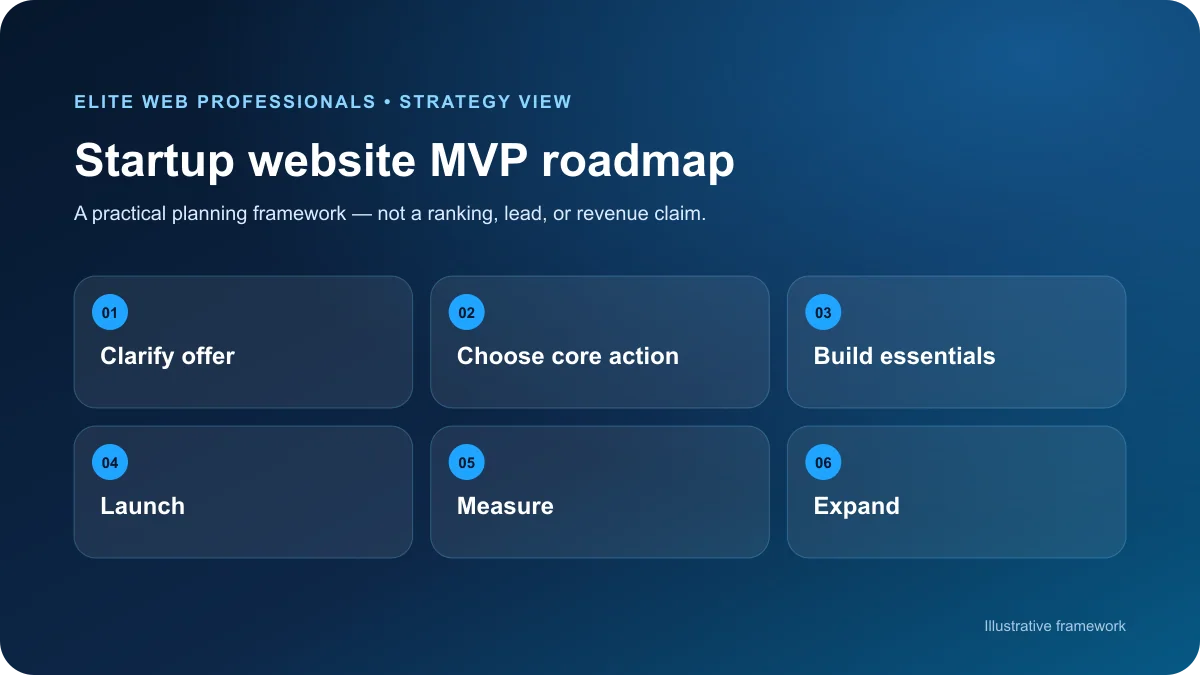
A professional MVP website includes the smallest intentional scope needed to communicate the offer, support the primary action, collect useful data, and create room for the next phase.
It may include:
An overbuilt startup website includes complexity before the business has validated the need.
Warning signs may include:
MVP does not mean careless, unfinished, or cheap.
It means the initial scope is intentional.
The website should be strong enough to represent the business professionally and focused enough to launch, learn, and improve.
The correct page set depends on the business model, audience, current stage, and primary action.
Possible pages include:
Introduces the problem, offer, audience, value, proof, and next step.
Explains what the company provides and how it helps the intended customer.
Breaks an unfamiliar process into clear steps.
Establishes who is behind the company and why the team is qualified to pursue the problem.
Presents approved pricing, packages, or a clear path toward a quote or consultation.
Shows how different customers or industries may use the product or service.
Answers the questions and objections that prevent action.
Creates the primary sales or discovery action.
Collects interest before the broader product or service is available.
Provides legitimate business contact information.
Presents client-supplied legal and privacy information appropriate to the business.
Supports education, search visibility, onboarding, or authority when the company can maintain useful content.
A startup does not need every page on day one.
The page set should support the current decision and the next realistic stage.
A startup can build trust without pretending to have an established company’s history.
Useful credibility signals may include:
The website should distinguish between a current capability and a future goal.
Do not present:
Honest positioning can be more persuasive than inflated startup language.

A startup should not expect immediate rankings simply because a new website launches.
However, the site should begin with a foundation that makes future search growth possible.
That foundation may include:
The startup should also decide whether search is a realistic early acquisition channel.
Some businesses operate in markets with established search demand. Others are introducing a new category that customers do not yet search for directly.
A startup with existing demand may benefit from service or product pages aligned with those searches.
A category-creating startup may need educational content, comparisons, use cases, partnerships, community, paid campaigns, or founder-led marketing before traditional SEO becomes a major acquisition channel.
The website architecture should support the market that actually exists.
A startup website should collect information that supports decisions.
Useful events may include:
The data can help the company refine:
Analytics should not become another unmanageable system.
Track the actions connected to business questions.
For example:
Early data does not automatically prove product-market fit. It provides evidence the team can combine with conversations, sales activity, customer feedback, and product usage.
A focused startup website can guide a visitor through a simple journey.
The visitor understands the problem and recognizes that the page is relevant.
The visitor learns what the startup provides and how it works.
The page presents founder experience, product proof, process, and verified trust signals.
The visitor evaluates pricing, use case, fit, risk, and the next step.
The visitor requests a demo, joins a waitlist, schedules a consultation, buys, applies, or submits a focused inquiry.
The company responds through its approved sales, CRM, email, or onboarding process.
The website should make that path clear without forcing every visitor into the same stage.

Founders are often sold features they do not yet need or given a template that cannot support growth.
Some agencies begin with a wish list of every future feature and turn the first website into an expensive software project before the startup has validated the workflow.
Others launch a minimal template that cannot explain the product, support marketing, or create trust.
Elite evaluates what the current stage requires, what can wait, and what foundation will make the next phase easier.
That may mean:
The goal is to be the last website and growth partner the startup needs by building an honest roadmap—not by locking the company into unnecessary complexity.
The client should understand what is being built, what it owns, what is deferred, and what evidence would justify the next phase.
A startup website should clearly explain the intended audience, problem, offer, value, process, founder or company, available proof, and primary next step. The exact pages depend on the business model and stage. A startup validating demand may need a focused landing page, while a company actively selling may need product, service, pricing, use-case, FAQ, and conversion pages.
An MVP website is the smallest professional website scope needed to communicate the offer, support the primary action, collect useful data, and learn without overbuilding. It should still be mobile-friendly, credible, trackable, and structured for expansion. MVP refers to intentional scope—not poor quality, missing information, or an unfinished customer experience.
Yes. A focused landing page can support market validation, a waitlist, demo requests, early sales, event registration, an application, or one specific campaign before a broader website is required. The page should connect the audience, message, offer, proof, CTA, form, and tracking so the startup can evaluate the response.
The website should launch with SEO foundations, but the size of the ongoing SEO investment depends on search demand, competition, business stage, content resources, sales timeline, and customer behavior. Startups entering an established search category may benefit sooner. Category-creating companies may need education and demand generation before SEO becomes a primary acquisition channel.
Yes, when the platform, architecture, content model, integrations, and page system are planned with reasonable expansion in mind. Scalability does not require building every future feature now. It means avoiding unnecessary decisions that make future pages, content, ecommerce, tracking, or approved functionality harder to add later.
Potentially. Custom functionality should be scoped after the users, workflow, data, permissions, integrations, technical requirements, and business value are defined. Elite will not recommend custom development merely because an idea is technically possible. Validation, platform capability, timeline, cost, and maintainability should guide the decision.
Yes. Elite can configure approved analytics and conversion events for forms, calls, demos, waitlists, booking actions, CTA clicks, traffic sources, and other meaningful website activity. The tracking plan should focus on the questions the startup needs to answer rather than collecting data with no clear owner or decision process.
Start with a Startup Website Strategy Call. Provide the offer, audience, current stage, desired customer action, launch timeline, existing assets, proof, content, platform preferences, integrations, and technical requirements. Elite will help identify the appropriate initial scope, what can wait, and which foundation supports the next stage.
Startup Website Design Atlanta should give a new company the credibility, clarity, mobile experience, conversion path, analytics, SEO foundation, and scalable structure needed for the next stage—without building unnecessary complexity before the market proves it is needed.
A stronger startup website begins with a clear decision: what must the customer understand and do now, what proof can the company support, and which future ideas should remain on the roadmap until the business has better evidence.
 173 W. Wieuca Road Northeast #104
 customersupport@advertisingbusiness.org
 (770) 874-6085