(770) 874-6085


 770-874-6085
Clear Product Architecture
Products, collections, categories, filters, menus, and search should reflect how customers shop—not only how the business organizes inventory internally.
Online Store Strategy • Mobile Shopping • SEO • Checkout • Analytics
Ecommerce Website Design Atlanta should make it easier for qualified shoppers to find products, trust the store, complete checkout, and return.
An online store can attract traffic and still lose sales through weak product organization, slow mobile pages, unclear shipping information, missing trust signals, difficult navigation, or a checkout that asks the customer to work too hard.
Elite Web Professionals builds and improves ecommerce websites around the customer journey and the operating reality behind the store—not simply around a theme.

Before you trust an agency with your website or search visibility, verify who they are and how they operate. Elite Web Professionals maintains public Better Business Bureau, Google Business Profile, and Yelp profiles, along with a live portfolio, reviews, and a documented Atlanta business presence. Professional proof should support the service—not replace the strategy behind it.
A store is supposed to make products easier to discover and purchase. Instead, many owners spend their time troubleshooting apps, answering questions the website should have resolved, manually fixing product information, checking whether forms and notifications work, and wondering why traffic is not becoming orders.
Common warning signs include:
Those are not only design problems. They may involve content, catalog architecture, development, integrations, platform choice, SEO, conversion, and operations.
You may have started with a do-it-yourself template because it was fast. You may have paid an agency to launch a beautiful store that never received organic visibility. You may be paying for apps that overlap, add friction, or make the site harder to maintain. You may have a developer who understands code but not the customer journey, or a marketer who recommends changes without understanding the technical system.
Elite is designed to be the last ecommerce website and digital-growth partner a business should need—not because the client is locked in, but because the work is organized around platform fit, ownership, documentation, conversion, analytics, search visibility, and continued improvement.
A conversion-focused store should help the right shopper move from interest to confidence to purchase.
Products, collections, categories, filters, menus, and search should reflect how customers shop—not only how the business organizes inventory internally.
Product media, descriptions, options, cart actions, shipping information, and checkout should remain usable from a smartphone without forcing customers to zoom, hunt, or restart.
A product page may need:
Customers may look for payment confidence, return information, contact details, business identity, shipping expectations, reviews, and clear policies before completing checkout.
The checkout should request the information required to complete the transaction without introducing unnecessary steps or distractions.
The store should be prepared to measure product views, add-to-cart actions, checkout activity, purchases, traffic sources, campaign behavior, and important funnel exits where the platform and tools support those events.
The right platform depends on the catalog, business model, content needs, integrations, internal workflow, ownership preferences, scalability, budget, and how the team plans to manage and market the store.
WooCommerce works well for businesses that want strong content flexibility, WordPress ownership, customizable product architecture, SEO control, and integration with a broader marketing website.
A WooCommerce project may be appropriate when content, service pages, educational resources, local SEO, lead generation, and ecommerce need to work inside one WordPress environment.
Shopify supports businesses that want a managed ecommerce platform with streamlined store administration, product management, checkout, app integrations, and a custom-branded storefront.
A custom Shopify store can improve the visual system, navigation, product organization, page templates, content, conversion path, and brand experience while retaining Shopify’s managed commerce environment.
BigCommerce can support larger catalogs, complex product structures, multichannel operations, and businesses that need a hosted ecommerce platform with room for more advanced requirements.
The decision should account for the actual catalog, integrations, product logic, team workflow, and long-term requirements.
Magento can support businesses with complex catalogs, specialized workflows, advanced integrations, and technical requirements that exceed a simpler storefront implementation.
Magento projects require careful scoping, technical resources, hosting, maintenance, and operational planning. The platform should be chosen because the business needs its capabilities—not because it appears more advanced.
Some companies need functionality, integrations, data flows, qualification tools, product logic, portals, pricing rules, or customer workflows that cannot be handled effectively by an off-the-shelf setup.
Custom ecommerce development should solve a verified business requirement. It should not add unnecessary complexity or make the system difficult for the company to operate.
Other ecommerce and legacy platforms can be reviewed individually. Elite will recommend whether the stronger path is repair, extension, redesign, migration, or rebuilding.
We do not force every company onto the same platform. We evaluate what exists, what can be preserved, what the business needs, and which technical path creates the strongest balance of usability, ownership, performance, maintainability, and growth.
Ecommerce SEO should not be added only to the homepage.
Search visibility may depend on:
A store with hundreds of products can still have very few useful search landing pages when the category structure is weak or the content provides little context.
Elite can build SEO foundations into the store and connect ongoing ecommerce SEO where the business wants continued organic growth.
Mobile-first ecommerce design means more than making product cards fit a smaller screen.
The mobile experience should make it easy to:
Third-party apps, popups, chat tools, media, fonts, tracking scripts, and payment options should be reviewed for mobile friction and performance.
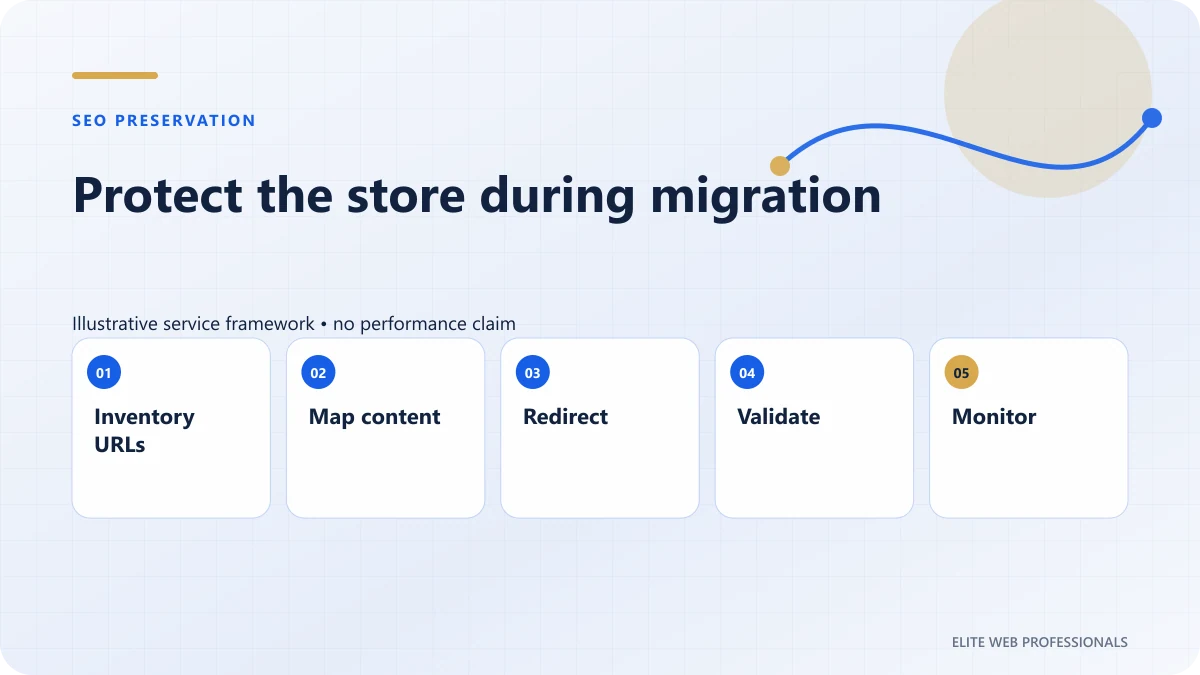
An ecommerce redesign may involve visual changes, catalog restructuring, platform migration, app replacement, checkout improvements, content updates, or SEO preservation.
The project should identify:
The replacement store is tested before switchover to reduce avoidable disruption.
Many redesign-related ranking losses can be reduced through URL mapping, redirects, content preservation, canonical checks, and post-launch monitoring. No company can guarantee that rankings or revenue will remain unchanged during every redesign or migration.
A store should help the business understand where shoppers continue and where they leave.
Depending on the platform and approved tools, tracking may include:
The objective is not to collect every possible event. The objective is to understand the actions that help improve merchandising, campaigns, content, and checkout.
Many ecommerce businesses reach Elite after receiving a generic store theme that never reflected the brand, a platform recommendation based on the agency’s convenience, or a redesign that ignored product SEO, tracking, and operational workflow.
Elite connects platform strategy, product organization, mobile shopping, design, development, SEO foundations, checkout, analytics, and long-term manageability. The goal is a store the business can operate and improve—not a visually impressive system that creates more confusion behind the scenes.
Ecommerce Website Design Atlanta pricing depends on the platform, catalog size, product structure, content, design, checkout, payment methods, shipping, taxes, integrations, migration needs, and custom functionality. Elite reviews the existing store or planned business model first, then recommends a scope based on the actual requirements.
Yes, Elite can plan an ecommerce redesign or migration around product data, URLs, redirects, content, canonicals, integrations, checkout, and testing. The replacement store is tested before switchover to reduce avoidable disruption. Rankings, orders, and revenue cannot be guaranteed to remain unchanged during every migration.
Yes. Ecommerce builds can include search-ready product and category architecture, metadata, internal links, mobile usability, structured data, canonicals, image optimization, and Search Console setup. Ongoing ecommerce SEO is a separate campaign when the business wants continued content, authority, technical, and organic-growth work.
Elite Web Professionals builds ecommerce websites with WordPress and WooCommerce, Shopify, BigCommerce, Magento, and custom ecommerce solutions. The right platform depends on catalog size, content requirements, integrations, internal workflow, ownership preferences, scalability, budget, and how the business plans to manage and market the store. We recommend the platform that fits the project rather than forcing every company into the same system.
Ownership follows the signed project agreement, platform terms, third-party licenses, and payment status. For completed and paid projects, client-owned content and agreed deliverables transfer according to the contract. Platform subscriptions, apps, domains, payment accounts, and third-party services may remain governed by their respective providers.
Common causes include weak buyer intent, slow mobile pages, poor product organization, incomplete product information, missing trust signals, unexpected shipping costs, checkout friction, or tracking that does not show where customers leave. An audit should examine traffic quality and the shopping experience before assuming the problem is only design.
The timeline depends on the platform, number of products, data quality, design approvals, content, integrations, migration, custom features, testing, and client feedback. Elite provides a production schedule after the scope and required access are confirmed rather than promising one timeline for every store.
Yes. Elite can provide ongoing maintenance, updates, troubleshooting, performance review, content changes, and supported optimization according to the hosting and maintenance agreement. Ecommerce websites often require more active attention because payments, apps, plugins, product data, and customer workflows must continue functioning together.
Ecommerce Website Design Atlanta works best when platform choice, product structure, mobile shopping, SEO, checkout, analytics, and ongoing support serve the same sales objective.
Your store should help customers find what they need, understand the product, trust the business, complete the purchase, and know what happens next. Elite can help evaluate the current store, choose the right platform, and build a practical roadmap around the business rather than the template.
BBB Accredited • Atlanta-Based • Verified Profiles • View Our Portfolio
 173 W. Wieuca Road Northeast #104
 customersupport@advertisingbusiness.org
 (770) 874-6085